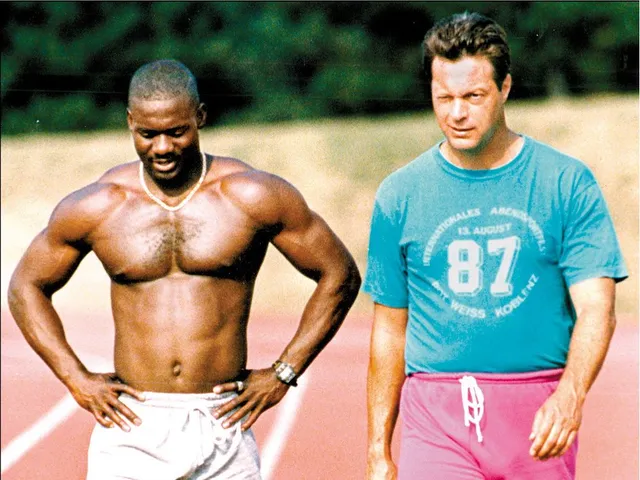
Ben Johnson Exclusive: The Training Blueprint Behind His Sprinting Legacy
Ben Johnson Exclusive: The Training Blueprint Behind One Of Sprinting’s Most Debated Legacies
Ben Johnson has spent decades being remembered through one race. But in a new WorldWide Entertainment TV exclusive, the Canadian sprint legend points to something bigger than the finish line: the training blueprint.
The first WWETV Media Short from the interview focuses on Johnson’s belief that he was part of a sprinting program that helped shape how speed, power, starts, and acceleration were understood at the highest level. For many viewers, Ben Johnson’s name still instantly brings up Seoul 1988, Carl Lewis, and one of the most controversial moments in Olympic history. But Johnson’s latest comments with WWETV open a different conversation.
Before the scandal became the headline, there was the athlete. Before the fall, there was the system. Before the world reduced him to one race, there was a training program that made him one of the most explosive sprinters the sport had ever seen.
Ben Johnson Says He Was Part Of The Blueprint
In WWETV’s exclusive interview, Johnson speaks about the Ben Johnson training program and the idea that his era helped create a model other sprinters would study long after the 1980s.
That is why this clip matters.
The point is not to erase the controversy. The point is to widen the frame. Johnson’s story is not only about what happened after the 100-meter final in Seoul. It is also about how he trained, how he started, how he accelerated, and why his running style became part of sprinting history.
Johnson has made similar points in recent public appearances. Speaking at the Kerala Literature Festival in 2026, he said sprinters are “born and not made,” but also emphasized determination, drive, passion, and years of sacrifice. He also described his start from the blocks and steep acceleration as his “secret weapon” during his rivalry with Carl Lewis.
That is the blueprint conversation WWETV is now bringing forward.
The Start, The Drive Phase, And The Power Question
When fans remember Ben Johnson, they often remember the image: the muscular sprinter in the red Canada uniform, exploding from the blocks, powering through the field, and crossing the line in front of Carl Lewis.
But sprinting is not just about top speed. It is about reaction, mechanics, strength, acceleration, rhythm, and the ability to maintain form under pressure.
Johnson’s advantage was often discussed through his start and drive phase. In his own words from the 2026 appearance, he said that after 1985, he beat Lewis in every competition and credited his start and acceleration as what separated him.
That is what makes the WWETV interview important. When Johnson talks about a training program, he is not simply revisiting old controversy. He is describing the physical architecture behind his sprinting identity.
The blocks.
The explosion.
The first 30 meters.
The power.
The confidence.
The belief that he had changed what sprinting could look like.
Seoul 1988 Still Frames The Story
No honest article about Ben Johnson can avoid Seoul 1988.
Johnson stunned the world by running 9.79 seconds in the 100 meters at the 1988 Olympics before being stripped of the gold medal three days later after testing positive for an anabolic steroid.
That moment became one of the most famous scandals in sports history. It changed Johnson’s life, reshaped Canada’s relationship with Olympic glory, and became a global reference point whenever people discuss performance, pressure, race, testing, fame, and punishment in elite sport.
But WWETV’s exclusive clip asks a different question:
Was Ben Johnson’s entire legacy reduced to the scandal, or did the sport still absorb parts of what made him dominant?
That is where the “blueprint” idea becomes powerful.
From Jesse Owens To Ben Johnson To Usain Bolt
WWETV’s visual framing connects Johnson to a larger sprinting timeline: Jesse Owens, Ben Johnson, and Usain Bolt.
Owens represents the past — the athlete whose Olympic greatness became part of world history, but whose story was often simplified through myth and politics.
Johnson represents the controversy era — the athlete whose speed shocked the world, but whose legacy became frozen around Seoul.
Bolt represents the modern future — the global sprinting superstar whose dominance was celebrated with joy, personality, and cultural protection.
Three eras.
Three fastest-man stories.
Three very different legacies.
That is why Johnson’s interview is not just a sports clip. It is a history question.
Who gets remembered as a pioneer?
Who gets remembered as a warning?
Who gets remembered as a legend?
And who decides?
The WWETV Angle: More Than One Race
WWETV’s strength is not simply posting a clip. It is documenting the receipt.
Ben Johnson speaking in his own voice gives the audience something that old headlines cannot provide: direct perspective from the man at the center of the story.
That does not mean viewers have to agree with every part of his interpretation. But it does mean the conversation can move beyond the same one-sentence version of history.
The training program matters because it shows that Johnson’s legacy was built before Seoul and debated long after Seoul. His name still comes up because his impact was not ordinary. The race became infamous because the performance was unforgettable.
That tension is the story.
The world remembers the scandal.
Johnson remembers the work.
WWETV is asking what happens when both are placed in the same frame.
Why This Clip Matters Now
The timing is important because modern sports culture is constantly revisiting old legacies. Documentaries, podcasts, archive footage, athlete interviews, and short-form clips are changing how fans judge figures from previous generations.
For younger viewers, Ben Johnson may be a name they only know through controversy. For older viewers, he represents a moment when Canada, Jamaica, the United States, and the Olympic world all collided in under 10 seconds.
The new WWETV clip gives both audiences a reason to re-enter the conversation.
Not to rewrite history.
To ask whether history became too small.
Watch The WWETV Exclusive Clip
Ben Johnson’s Blueprint clip is now available through WorldWide Entertainment TV’s rollout, with more exclusive interview moments coming soon.
The first chapter centers on the training program and the idea of Johnson as part of a sprinting blueprint.
The next chapter will continue the larger conversation around legacy, judgment, and how the story of speed gets passed from Jesse Owens to Ben Johnson to Usain Bolt.
Because when an athlete is remembered through one moment, the question becomes bigger than sport.
Was Ben Johnson just one race?
Or was he part of the blueprint?
Share this content:










Post Comment