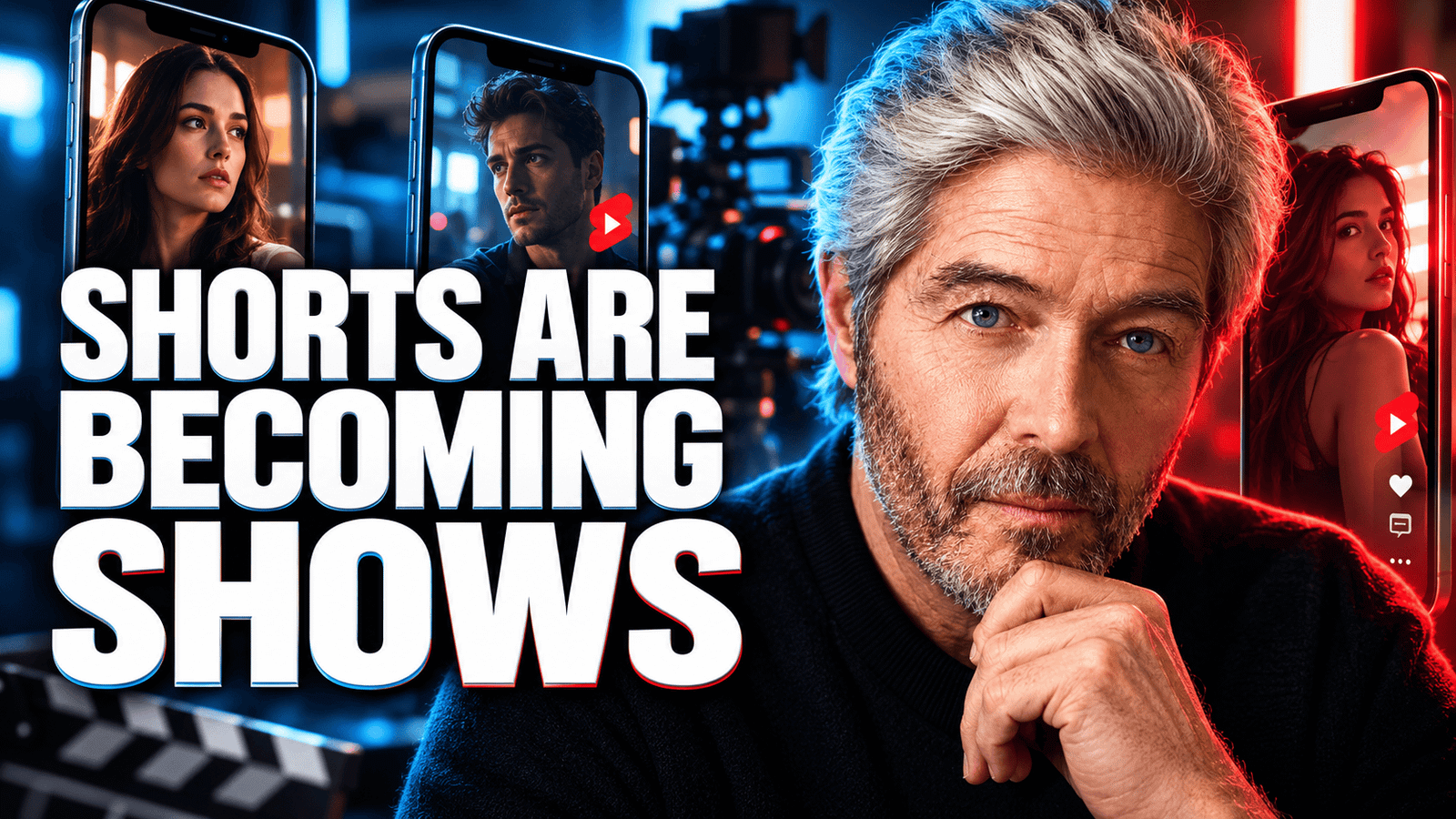
YouTube Shorts Series: Buzz Leer Explains the Micro-Drama & Vertical Entertainment Boom
YouTube Turns Shorts Into Shows as Buzz Leer’s Vertical Entertainment Prediction Comes Into Focus
Weeks before YouTube unveiled its new Shorts Series feature, actor and The Vertical Buzz host Buzz Leer sat down with WorldWide Entertainment TV to explain why vertical entertainment was no longer a passing trend—and why short-form platforms were becoming places to watch actual shows.
The line between social video and television is getting thinner.
At its Made On YouTube event on September 23, YouTube announced Shorts Series, a new feature allowing creators to organize Shorts into seasons and episodes with custom thumbnails and sequential playback across mobile, web and television. YouTube said microdramas generated more than 6.5 billion views during the first half of 2026, with watch time increasing more than 50% year over year. YouTube Blog
For WorldWide Entertainment TV, the announcement arrived with unusual timing.
Before YouTube unveiled the feature, WWETV had already recorded an in-depth conversation with Buzz Leer, an actor, host and veteran of the rapidly expanding vertical-film industry. Leer told WWETV that the question surrounding vertical entertainment was no longer whether the format was real.
“It is not a trend anymore. It’s definitely here to stay.”
Leer said he had appeared in approximately 45 vertical films in three years, describing a production ecosystem that had rapidly evolved from small crews experimenting with smartphones into full professional film sets. Pasted text
His traditional entertainment background gives him another perspective on the transition. Leer has worked across television and film, with credits including HGTV’s House Detectives, FOX’s neXt and NBC’s Chicago P.D. and Chicago Fire, while his more recent work has placed him directly inside the vertical-film boom. Amazon Music
From Shorts to actual episodes
One of the most striking portions of WWETV’s interview now sounds particularly timely.
Leer explained that a vertical production may still resemble a traditional 90- or 120-minute film during production. The major difference comes in how that story is delivered.
Instead of asking audiences to sit through one uninterrupted feature, the production is divided into one- or two-minute episodes, with cliffhangers engineered to move viewers immediately into the next installment.
Leer described it simply as a full-sized film transformed into “episodic entertainment.” Pasted text
That is remarkably close to the experience YouTube is now building directly into Shorts.
Under Shorts Series, creators can arrange Shorts as seasons and episodes rather than relying on viewers to stumble across Part 2, Part 3 or Part 4 individually. YouTube says sequential playback is intended to make episodic Shorts easier to discover and continue watching. YouTube Blog
TechCrunch characterized the move as YouTube making a more direct play for the growing microdrama market, where platforms including ReelShort and DramaBox have already demonstrated demand for serialized vertical entertainment. TechCrunch
Buzz Leer: short-form platforms should “show shows”
Perhaps the most relevant moment in the WWETV conversation came when Leer was asked whether YouTube Shorts, TikTok and Instagram should primarily function as promotional trailers directing audiences toward longer programming.
His answer was straightforward.
“I would use it to show shows.” Pasted text
That distinction matters.
For years, creators and traditional media companies have often treated short-form video as marketing: cut a highlight from a longer interview, tease a television episode or use a Reel or Short to redirect viewers somewhere else.
The microdrama model flips that relationship. The vertical video is the program.
YouTube’s latest product direction appears to acknowledge the same behavioral shift. The company says Shorts Series is designed not only for mobile viewing but for connected televisions as well. It also reported that microdrama viewing on TV increased more than 90% year over year, despite the format’s mobile-first origins. YouTube Blog
That creates a strange but increasingly plausible media loop: stories designed vertically for phones are now becoming episodic shows—and those vertical shows are beginning to appear on the biggest screen in the house.
Why vertical entertainment keeps growing
Leer believes the format’s strength begins with an obvious piece of technology people already carry everywhere.
“Until this vertical device of a phone goes away, it’s not going anywhere.”
But he argues the growth extends beyond screen orientation.
During the interview, Leer described vertical entertainment as an emerging ecosystem, not simply a filmmaking technique. He pointed toward expansion into sports, branded storytelling and other categories while arguing that creators and companies were beginning to build entire businesses around mobile-first entertainment. Pasted text
He also argued that the real innovation was not merely turning a camera sideways. It was pacing.
Vertical dramas are written around continuous hooks and cliffhangers, with every episode needing to create sufficient curiosity to propel viewers into the next one. Pasted text
That storytelling philosophy has obvious implications beyond dedicated microdrama platforms.
It increasingly resembles the broader mechanics of Shorts, TikTok and Reels: earn attention immediately, maintain momentum and create a reason for the viewer not to leave.
Hollywood is paying attention
Leer told WWETV that traditional Hollywood has begun recognizing the financial potential of vertical entertainment, although he believes established companies are still learning how to operate within the format.
Rather than viewing vertical video as something that will replace Hollywood, he described it as “a brand new lane of entertainment.” Pasted text
The industry is already drawing recognizable entertainment figures and producers. Recent vertical projects have involved established Hollywood talent, while creators and production companies continue to build dedicated mobile-first studios and platforms. TechCrunch noted participation from names including Issa Rae, James Franco and Jesse Tyler Ferguson as the category expands. TechCrunch
Leer also sees opportunity for independent creators and media companies that already control their own archives and intellectual property.
Asked by WWETV whether a company owning years of interviews, documentaries, music footage and entertainment archives should adapt that existing material for vertical audiences or create completely new franchises, Leer encouraged owners to begin with IP that has already demonstrated value.
He later told WWETV that an archive could become more valuable in the vertical era because older material can be rediscovered and reformatted for new audiences. Pasted text
That concept has obvious consequences for legacy media.
The next major vertical series may not begin as something completely new. It could begin with a story, character, interview or cultural moment audiences already know—rebuilt for a different screen and a different rhythm of consumption.
YouTube’s announcement makes the conversation more timely
WWETV’s interview with Buzz Leer was not recorded in reaction to Shorts Series.
That is precisely what makes its release now particularly relevant.
Leer was already describing vertical entertainment as durable, episodic and increasingly capable of standing as the entertainment product itself. Days later, YouTube formally introduced infrastructure allowing creators to package Shorts into seasons and episodes.
That does not mean every prediction Leer made has been resolved. He actually told WWETV that while he expects YouTube to become increasingly dominant in streaming overall, he believes TikTok could ultimately become the strongest force in vertical entertainment specifically. Pasted text
But YouTube’s newest move shows that the battle over vertical entertainment is no longer theoretical.
The platforms are beginning to build for it.
And as Leer told WWETV near the conclusion of the interview, five years from now the industry may not even need the word “vertical.”
It may simply be called entertainment. Pasted text
Watch the full WorldWide Entertainment TV interview with Buzz Leer on WWETV Media.
Share this content:








Post Comment