
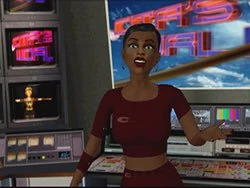
Before AI Hosts, BET Had Cita’s World
Before Today’s Virtual Hosts, BET Had Cita—and MuchMusic Had Master T and Roxy
Long before virtual influencers, AI presenters, and animated digital personalities became common online, television had already begun experimenting with hosts who existed somewhere between broadcasting, animation, and technology.
BET’s Cita’s World and MuchMusic’s Master T and Roxy were early examples of that idea.
These personalities were not created with today’s generative artificial intelligence. They were produced through animation, video design, scripted performances, and traditional television production. But they introduced an important possibility: a host did not necessarily have to function like a conventional television personality.
Cita could represent a world built around music, youth culture, and entertainment while existing as a digital character. On MuchMusic, Master T and Roxy offered another version of that concept, blending recognizable broadcasting personalities with a highly stylized visual environment.
For viewers growing up in the 1990s and early 2000s, these figures were part of the television landscape. They were not simply technical experiments. They were connected to the music, culture, and visual language of their time.
That is what makes them worth revisiting today.
Modern audiences are now familiar with virtual hosts, animated influencers, digital news presenters, and AI-assisted personalities. Yet the idea of a digital host did not begin with social media. Television networks had already begun asking how technology could expand the traditional host format.
The difference is that the earlier versions were shaped by the creative tools available at the time. Instead of artificial intelligence generating a personality in real time, producers built characters through animation, editing, visual effects, and performance. The technology was different, but the question was similar:
What makes someone feel like a host?
Is it a real face? A recognizable voice? A strong point of view? A relationship with the audience?
Cita, Master T, and Roxy demonstrated that audiences could connect with a host through style, attitude, and cultural relevance—even when the presentation was highly constructed.
That history also provides context for today’s digital personalities, including WWETV’s Lisa and Ava. Lisa represents a faster, more current, debate-oriented style associated with WWETV Network. Ava carries a more reflective and archival tone connected to WWETV Studios.
Their presence belongs to a longer evolution of entertainment media experimenting with the relationship between technology and personality.
But the history is more important than the technology itself. The real story is not simply that television once used animated characters. The deeper story is that media companies have repeatedly searched for new ways to make information, music, and culture feel personal.
Cita’s World, Master T, and Roxy were products of their moment. Lisa and Ava are products of another. Between them is a continuing conversation about how audiences meet hosts, how hosts build trust, and how technology changes the way culture is presented.
Looking back also reminds us that innovation is rarely as new as it first appears. Many ideas that seem groundbreaking today have earlier versions hidden in television history.
Before virtual creators became a major part of the internet, music television had already introduced viewers to hosts who could move between the human and digital worlds.
Cita, Master T, and Roxy were not identical to today’s AI personalities. They did not use the same tools or operate in the same media environment. But they helped make the concept familiar: a host could be designed, stylized, animated, and still become part of the audience’s cultural memory.
That may be their lasting contribution—not predicting the future perfectly, but showing that television had already begun imagining it.
Share this content:









Post Comment