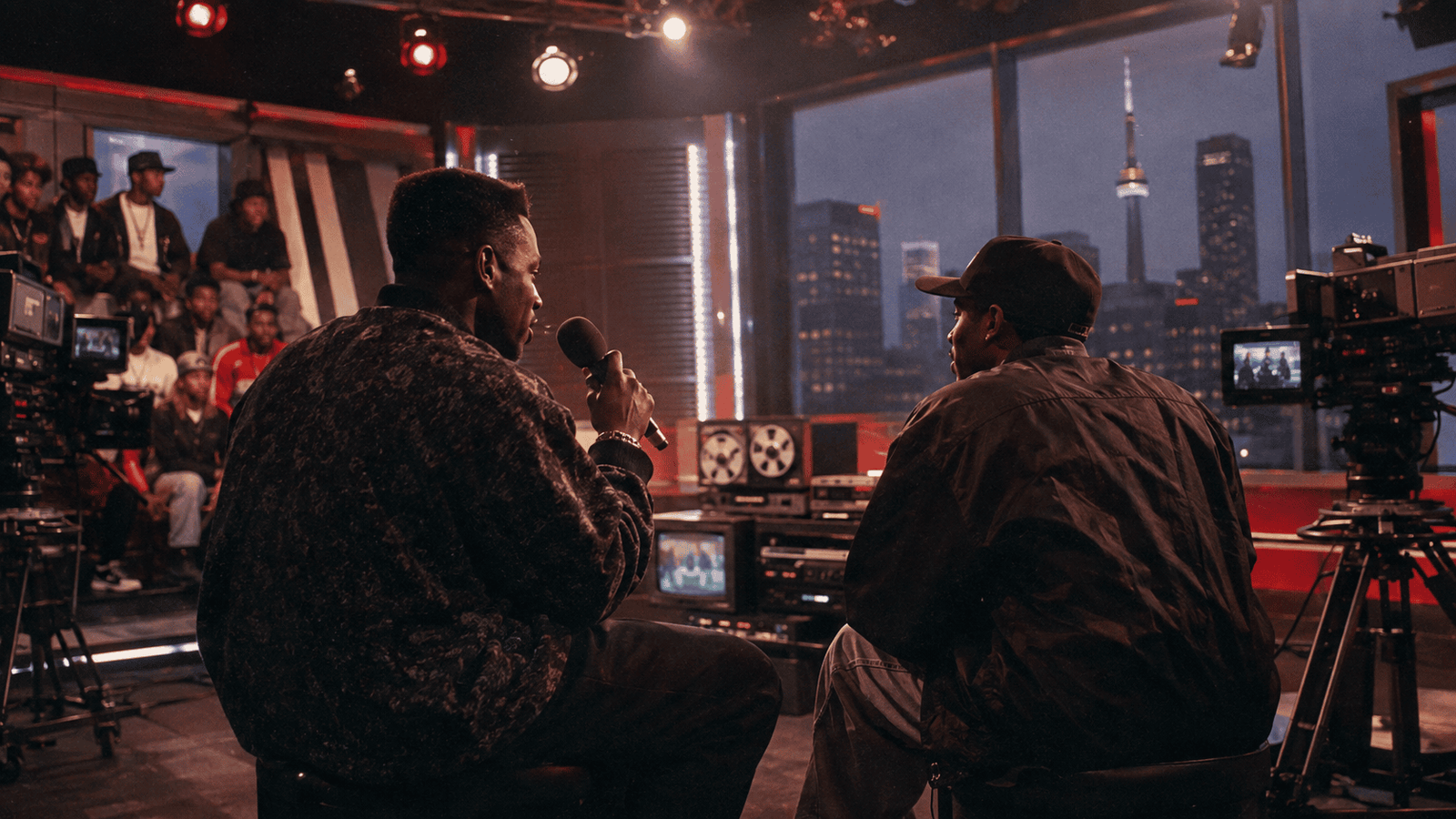
Master T: The Toronto TV Legend Behind Tupac’s Last Major Interview
Tomorrow, September 4, 2026, marks 30 years since Master T conducted his historic September 4, 1996 interview with Tupac Shakur for MuchMusic.
The timing alone ensured the footage would endure. Recorded after the MTV Video Music Awards in New York and only three days before Tupac was shot in Las Vegas, the conversation became one of the clearest televised windows into the rapper’s plans during his final week.
Yet reducing Master T’s career to “the last person to interview Tupac” misses the larger legacy. Long before artists could reach a national audience through social media, he helped create television space for hip-hop, R&B, reggae, dancehall and Canadian music. The Tupac exchange is a landmark within that work—not the whole story.
Master T helped Black music reach Canadian television
Tony Young, known to viewers as Master T, became one of the defining personalities of MuchMusic’s urban-music era. He began behind the camera, then emerged as a producer and VJ whose credibility came from treating the music and its audience as a culture rather than a programming trend.
His signature platform began as X-Tendamix and evolved into Da Mix. Across those programs—and through his other MuchMusic work—Master T interviewed international stars while consistently making room for Canadian talent. He connected hip-hop with R&B, reggae and dancehall in a way that reflected the music actually circulating through Toronto and other Canadian cities.
That contribution is easy to underestimate from the streaming era. In the early 1990s, a television appearance could provide visibility that radio formats, print coverage and major-label priorities did not. MuchMusic reached homes across Canada. When Master T put an artist, video or conversation on screen, he helped make Black music part of the national record.
He was not simply presenting songs. He was helping audiences see a Canadian cultural identity taking shape.
The Master T Tupac interview on September 4, 1996
Tupac arrived at the MTV VMAs amid enormous attention around Death Row Records, the East Coast–West Coast conflict and his next moves in music and film. During Master T’s interview, the broadcaster asked him directly about Death Row East.
Tupac’s reply became instantly memorable: “Do you believe in God? Then believe in Death Row East.”
The line carried the force of a slogan, but the interview around it matters just as much. Master T was asking a focused question about an expansion Tupac was actively promoting. The exchange therefore preserves more than celebrity energy; it captures an artist articulating a business and cultural ambition only days before his death.
Earlier VMA press material involving Tupac and Snoop Dogg also survives. On September 7, BET captured a brief spontaneous exchange at the MGM Grand after the Mike Tyson–Bruce Seldon fight. Those distinctions are why the most defensible description of Master T’s footage is one of Tupac’s final major television interviews—and arguably his last substantive one-on-one TV interview.
It should not be inflated into the unsupported claim that no human being interviewed Tupac afterward. Historical precision makes the MuchMusic tape more credible, not less important.
Later that September 4 evening came Tupac’s famous Bryant Park encounter with Nas. It belongs to the same compressed New York timeline, but it should remain separate from what the camera proves about Master T’s interview. There is no need to imply that Master T witnessed every part of the later encounter in order to understand the extraordinary sequence of that night.
A Toronto archive recorded in New York
The location was New York, but the broadcasting history is Canadian.
MuchMusic was based in Toronto, and Master T’s reporting brought the interview to a Canadian audience. That distinction matters because hip-hop history is often narrated through American record labels, American magazines and American television networks. Canadian media did not merely watch the culture from a distance; its broadcasters documented key moments and built platforms for artists on both sides of the border.
Master T’s Tupac interview is one of the sharpest examples. A Toronto-based music channel preserved a pivotal statement from one of the most scrutinized weeks in rap history.
The same sensibility shaped his support for homegrown music. By putting Canadian performers in proximity to international stars, X-Tendamix and Da Mix helped communicate that Canadian hip-hop and Caribbean-influenced music belonged in the national mainstream.
The WWETV archive kept the story visible
On November 9, 2017, WWETV Media published “Last Man To Interview Tupac on TV Speaks – Master T.” The feature combined archival Tupac and Master T material with footage of Master T appearing publicly at a Dan-e-o concert event in Toronto.
An on-screen historical reference identified the September 4, 1996 Tupac interview. The larger feature placed that moment beside Canadian hip-hop history and the importance of national television exposure.
The video is evidence of WWETV’s continuing effort to preserve the intersection of Toronto music history and Tupac history. It does not prove that WWETV invented the “last interviewer” designation, nor does it justify speculation about what later archives may have seen. Its value is straightforward: WWETV was publicly documenting the distinction in 2017 and connecting it to the Canadian story around Master T.
That archival continuity matters. Digital platforms can make old footage suddenly feel new, but preservation requires people to label, contextualize and recirculate it before an anniversary makes it trend again.
The legacy is bigger than “last”
WWETV has reached out to Master T again as the 30th anniversary arrives. A new conversation could expand the record with his memories of the interview, MuchMusic’s role and the evolution of Canadian hip-hop media.
But the anniversary already carries a clear lesson.
Master T’s importance does not depend on winning an absolute argument over the last words Tupac ever gave a camera. His legacy lives in the quality of the conversation, the timing of the footage and the national platform he helped build for Black music.
The interview is a portal into September 1996. Master T’s career is a map of how Canadian music television helped make artists, scenes and communities visible before every moment could become instantly global.
Share this content:









Post Comment