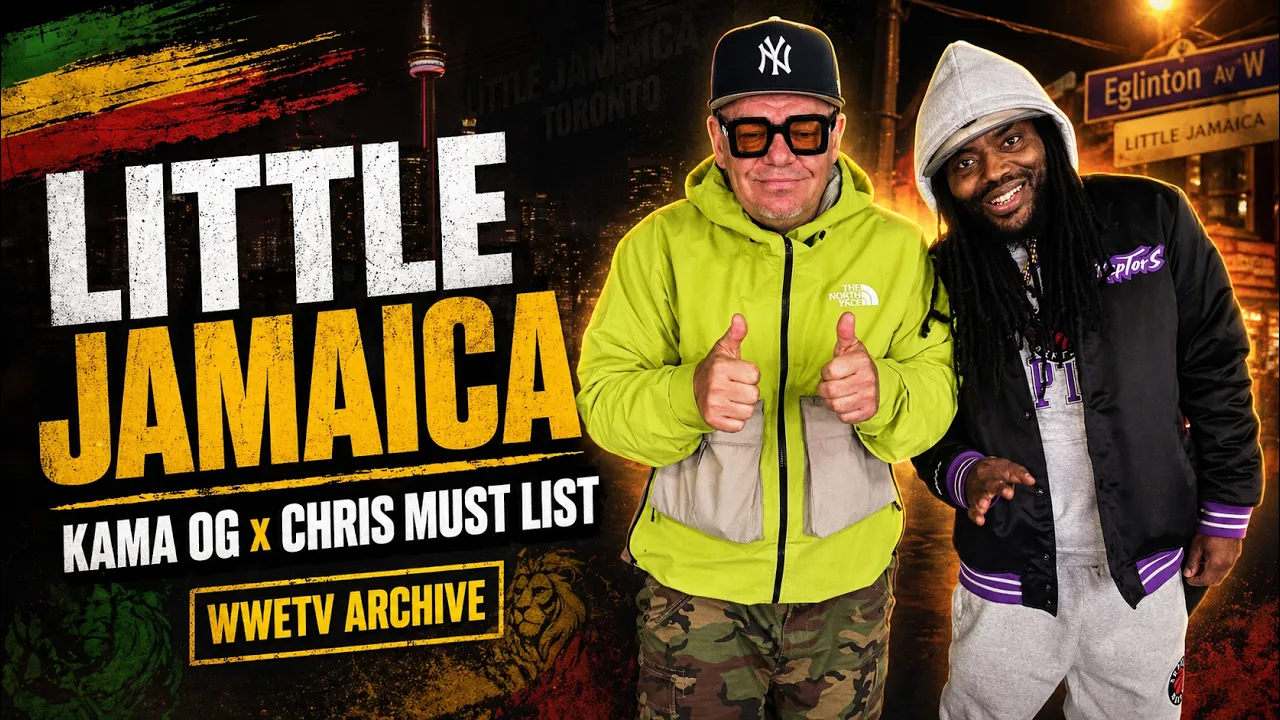
Christ Must List Links With Kama OG Origin Podcast In Toronto
Chris Must List Shows Little Jamaica — WWETV’s Before The 6 Archive Goes Deeper
WorldWide Entertainment TV connects Chris Must List’s new Little Jamaica vlog with the deeper Toronto archive — from Phil Vassell and Jay Douglas to Kama OG, Vaughan Road, Drake, and the roots of the city before The 6ix became global.
Chris Must List has brought fresh attention to one of Toronto’s most important cultural neighborhoods with his new vlog, “The Death of Little Jamaica in Toronto.” The video walks through Eglinton West, Little Jamaica, and Oakwood-Vaughan, showing the beauty, struggle, history, and changing face of an area that has carried Caribbean culture in Toronto for generations.
But for WorldWide Entertainment TV, this story goes much deeper than one viral vlog.
WWETV has been documenting Toronto’s music and street-culture history for years through the Before The 6 archive, original Little Jamaica coverage, legacy interviews, and the ongoing Kama OG Toronto Stories / Origin Stories series. That is why the new WWETV Media feature, “Chris Must List Showed Little Jamaica — WWETV’s Before The 6 Series Archive Goes Deeper,” connects the current conversation to the city’s larger cultural foundation.
Before Toronto was branded globally as The 6ix, neighborhoods like Little Jamaica, Eglinton West, Vaughan Road, and Oakwood-Vaughan were already shaping the city’s Caribbean identity, Black music history, reggae scene, street culture, and hip hop foundation.
Little Jamaica Was More Than A Strip On Eglinton West
Little Jamaica has long been recognized as a Caribbean cultural hub in Toronto. The neighborhood became known for its restaurants, barbershops, record stores, music spaces, late-night food culture, and community gathering spots.
In WWETV’s interview with Phil Vassell, Executive Director of the Canada Black Music Archives, Vassell explained why documenting this history matters. He spoke about the responsibility to research, collect, and share Toronto’s Black music history, while also highlighting Little Jamaica’s role as a major reggae and R&B corridor. Vassell also noted that Toronto was once considered one of the most important reggae production centers outside of Kingston, Jamaica, and that the Little Jamaica Music History Walking Tour was created to preserve those stories.
That context matters because Little Jamaica is not just a backdrop. It is part of the infrastructure that helped build Toronto’s Black music identity.
Phil Vassell, Jay Douglas, And Toronto’s Reggae Legacy
One of the key names connected to this history is Jay Douglas, a three-time Juno Award nominee, producer, band leader, and longtime figure in Toronto reggae.
Douglas’ career stretches through the Caribbean nightclub scene in Toronto and Montreal, where his group The Cougars performed throughout the 1960s and 1970s. His legacy connects to ska, rocksteady, reggae, rhythm and blues, soul, and funk — the exact blend of sounds that helped shape Toronto’s Caribbean music foundation.
WWETV’s archive interview with Jay Douglas now carries even more importance as Little Jamaica receives renewed attention. Phil Vassell has spoken about the importance of documenting artists such as Jay Douglas, Leroy Sibbles, Jackie Mittoo, Nana McLean, Johnny Osborne, and Stranger Cole in relation to Toronto’s Black music story.
That is why WWETV is also bringing the Jay Douglas interview back into public view as part of the larger Little Jamaica and Before The 6 archive.
Kama OG Connects Little Jamaica To Oakwood-Vaughan
Chris Must List’s video becomes especially important when it moves from Eglinton West into Oakwood-Vaughan, where Kama OG helps explain the deeper neighborhood layers.
Kama speaks from lived experience. His perspective connects Little Jamaica’s Caribbean roots with Vaughan Road, Oakwood-Vaughan, after-hours culture, street history, local artists, neighborhood memory, and the evolution of Toronto before and after the global Drake era.
This is where WWETV’s ongoing Kama OG series becomes essential.
The Kama OG Toronto Stories / Origin Stories series was built to preserve these kinds of voices — people who can explain what the city was before the mainstream spotlight, before global branding, and before outside media reduced Toronto’s story to a few famous names.
Before The 6: The Toronto Story Was Already Being Written
WWETV’s original documentary “Now or Never: Before The 6 — The Foundations of Toronto Hip-Hop” helped document Toronto’s early hip hop foundation before the city became globally known as The 6ix.
That history includes more than one artist, one era, or one neighborhood. It includes communities across the city — Little Jamaica, Vaughan Road, Jane and Finch, Regent Park, Scarborough, Rexdale, Parkdale, and many other areas that contributed to the sound, style, and identity of Toronto music.
Chris Must List’s vlog has opened the current conversation for a wider YouTube audience, but WWETV’s archive helps connect the dots:
Little Jamaica was a Caribbean music hub.
Vaughan Road and Oakwood-Vaughan carried street and hip hop history.
Jay Douglas represents the reggae legacy.
Phil Vassell represents the archive and historical documentation.
Kama OG represents the lived neighborhood memory.
Drake and The Weeknd represent the global era that followed.
Drake, Vaughan Road, And The Global Toronto Era
One of the most searchable layers in this conversation is Drake’s connection to Toronto’s west-end history. In the Chris Must List video, Kama OG points to Vaughan Road Academy and discusses Drake’s connection to the school during his early Degrassi years.
That moment matters because it shows how the old Toronto and the global Toronto are connected. Before Drake became one of the biggest artists in the world, the city already had neighborhoods, schools, studios, artists, and cultural routes that shaped the environment around him.
WWETV’s deeper archive does not use Drake to erase the older story. It uses that connection to explain how Toronto’s global moment grew from a much older foundation.
Why This Story Matters Now
The title of Chris Must List’s video is provocative, but the bigger question is not simply whether Little Jamaica is “dead.” The more important question is whether Toronto is willing to preserve the people, businesses, artists, and cultural spaces that made the neighborhood matter in the first place.
Little Jamaica still carries history. It still carries memory. It still carries the sound of reggae, dancehall, R&B, hip hop, Caribbean food, barbershop culture, late-night community, and immigrant survival.
But history can disappear if it is not documented.
That is why WWETV’s new Media feature is more than a response video. It is part of a larger preservation effort.
WWETV’s Archive Goes Deeper
WorldWide Entertainment TV’s coverage connects the current Chris Must List moment to years of Toronto documentation:
Before The 6 preserved the foundation of Toronto hip hop.
Phil Vassell’s interview preserved the Black music archive perspective.
Jay Douglas’ interview preserved the reggae legacy.
Kama OG’s series preserves the street-level Toronto memory.
Little Jamaica coverage preserves the neighborhood story behind the culture.
Chris Must List helped put new eyes on Little Jamaica. WWETV’s archive explains why that attention matters.
Before The 6 became a brand, it was a foundation.
And Little Jamaica was part of that foundation.
Share this content:







Post Comment