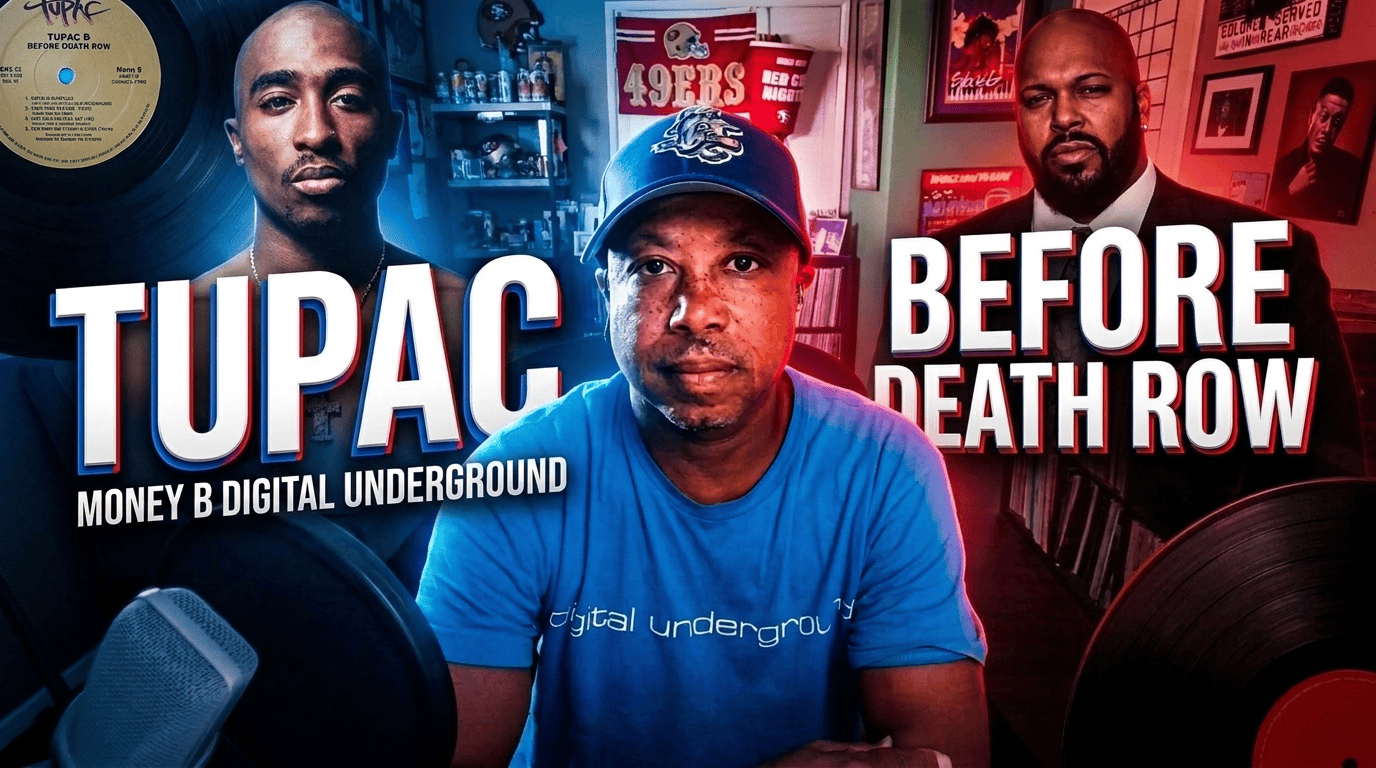
Money B: Death Row Didn’t Create Tupac | WWETV
Money B: Death Row Didn’t Create Tupac — “He Was Always That Guy”
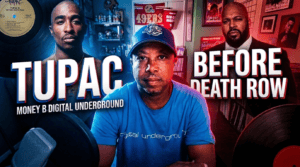
Digital Underground’s Money B sits down with WWETV to set the record straight on Tupac Shakur’s evolution, Shock G’s overlooked genius, and what he hopes the Tupac murder trial ultimately delivers for the Shakur family.
There’s a version of Tupac Shakur’s story that gets told in three neat acts: the playful backup dancer, the movie star who played a gangster named Bishop, and finally the “super-thug” who emerged once he signed to Death Row Records. It’s a tidy arc. According to Money B — the man who stood next to Tupac through nearly all of it — it’s also wrong.
“People like to make everything black and white, cut and dry,” Money B told WWETV. “That he was this dancer dude that did the movie and then became this thug dude. And then he got with Death Row and became this super duper gangster dude in his mind. That’s not what happened. He always has been who he was.”
That single idea — that fame didn’t transform Tupac so much as finally put him in focus — became the throughline of a wide-ranging conversation recorded days after the Tupac murder trial opened in Las Vegas, nearly 30 years after his death.
Raised to Understand Him
Money B and Tupac’s connection didn’t start with music. It started with a shared upbringing inside the Black Panther Party’s orbit.
“Because we both came from the background of being raised by parents of the Black Panther Party, I sort of understood his language in a sense,” Money B said. “It wasn’t like Tupac and I sat around and had meetings about what we learned in the Black Panther Party, but we did have this understanding of where we both came from. He never had to explain what he was saying to me.”
Money B grew up attending the Oakland Community School, founded by Black Panther Party co-founder Huey P. Newton — a detail he expands on in his upcoming autobiography. That shared foundation, he says, is also why he’s never bought into the idea that Tupac’s political, playful, angry, and vulnerable sides were contradictions.
“People can say it’s contradictory. I just call it being human,” he said. “We all have emotions. You can have different emotions at different times. That doesn’t mean because you feel one way at one time that you don’t feel another way at another time… He was a young man. He died when he was twenty-five years old.”
The Party Was the Message
Long before Tupac joined, Shock G had already built Digital Underground around an idea that history hasn’t fully credited him for. Money B says the group’s reputation as hip-hop’s party act obscures how deliberate — and how political — Shock G’s vision actually was.
“When Shock G originally imagined Digital Underground, he had more of a militant group idea, like Public Enemy. But Public Enemy kind of occupied that lane,” Money B explained. “If you really deep dive into Digital Underground’s catalog and our lyrical content, those messages that he wanted to get out were still there. He just layered it with the fun and the antics and the theatrics.”
Ask most fans what they know about Shock G, Money B says, and the answer stops at Humpty Hump. “Shock G was more than just a character wearing a nose. Shock G was an accomplished musician. Shock G was a musical genius.” Both George Clinton and Prince — two of Shock’s own idols — requested his production work directly. “Sometimes I think that’s enough,” Money B said. “The general public, we always need boxes to fit you in and to latch onto.”
What Shock Saw in Tupac
By the time Tupac joined Digital Underground as a roadie, dancer, and hype man, Money B says the group already sensed something larger forming.
“He was extremely talented, extremely driven, extremely focused — in some areas well mature behind his age, and obviously immature in other areas, which we all were,” Money B said of what Shock G recognized. “But he definitely was destined to be what he became. God didn’t make a mistake, for sure.”
Nobody predicted the scale of what came next, Money B is careful to note — not even Tupac himself. But nobody around him put a ceiling on it, either. “We never gave Tupac a ceiling,” he said. “We thought that he was talented enough and had the it factor to be whatever he wanted to be.”
That early belief collided with commercial reality when Tupac’s debut album, 2Pacalypse Now, underperformed out of the gate. “I don’t even think he did a hundred thousand record sales when 2Pacalypse Now first came out,” Money B said. What kept Interscope Records patient, he believes, wasn’t the numbers — it was the same star quality everyone around him had already clocked. “All Tupac needed was the right vehicle. He was a star. He just needed the right vehicle for everyone to recognize him as such.” That vehicle arrived alongside the album, in the form of his breakout role in Juice.
Bishop Didn’t Change Him — It Revealed Him
Which brings the conversation back to its central argument. Money B and the rest of Digital Underground read the script for Juice years before Death Row existed, and they saw Tupac in it immediately.
“I read the script — myself, [Shock G], and others — we recognized that this character kind of reminded us of Tupac, and we knew Tupac could act, and we knew that he would probably nail that character,” Money B said. “It wasn’t like he did the movie and tried to become this Bishop character. Some of that was already in Pac.”
He points to something else the public rarely connects to that idea: a widely circulated account of the night Tupac was shot in 1994, in which he reportedly told police, “No, we’ll take care of it,” rather than naming a suspect. Fans have pointed to the moment as proof he was “really like that” — not performing a persona. Money B agrees, with a caveat.
“He was always who he was,” he said. “Now, you also have to understand that situations and experiences change us as a person. If something dramatic happens to you in your life, you will change and evolve.” Getting shot, and suspecting people close to him may have been involved, would understandably make anyone more guarded, he says — that’s evolution under pressure, not a persona swap.
What Justice Looks Like Now
Asked what he hopes the ongoing murder trial ultimately delivers, Money B kept the focus on the Shakur family — while making clear he believes the case extends beyond the man currently charged.
“I hope that [Keefe D] is made accountable for his involvement,” he said, noting that Keefe D has described his own role publicly across a book and numerous interviews. But Money B stopped short of treating the case as closed once a verdict lands. “I think it’s more than just four people — and the guy that pulled the trigger — that should be made accountable for Tupac’s death,” he said, adding that he believes other individuals were involved in the events surrounding the killing. He was careful to frame it as his own belief rather than a claim of fact.
The Book, and What Comes Next
Money B’s autobiography, A D.U. Party Don’t Stop, arrives October 13 — part memoir, part firsthand account of five decades of American history seen from Oakland outward, from the Black Panther Party era through the crack epidemic to Digital Underground’s rise and its long life after the hits stopped charting.
“For me, it’s more of an American history tell,” he said. “I bring you firsthand experience through like five decades of the American experience of someone that comes from the inner-city community like I did.”
The book is available for preorder now at DU Merch and Amazon Kindle, with signed paperback preorders through DU Merch including a personal audio thank-you message from Money B himself.
As for what he hopes people take from Digital Underground’s legacy, and Tupac’s, decades on — Money B doesn’t think there’s much left to correct. “This is what we do when stars pass. We keep their name alive. We continue to celebrate, we continue to debate about them,” he said. “If Tupac and Shock are looking down now… they’re talking about us. Even though we’re not here, we’re still alive. Because our name carries, and will carry forward, probably forever.”
This interview has been edited and condensed for clarity. Watch the full conversation on WWETV Media.
Share this content:




Post Comment