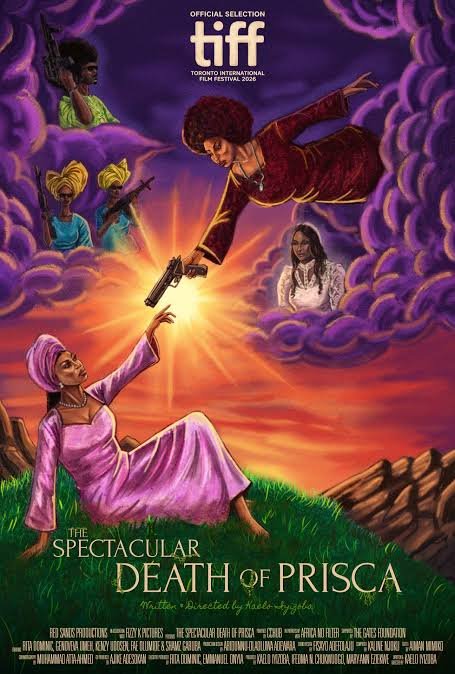
Rita Dominic Discusses TIFF & The Spectacular Death of Prisca
Nollywood icon Rita Dominic has returned to the Toronto International Film Festival ten years after the world premiere of ’76, this time with the bold and imaginative short film The Spectacular Death of Prisca.
Speaking exclusively with WorldWide Entertainment TV following the film’s TIFF world premiere, Dominic reflected on her nearly three-decade career, the international impact of early Nollywood and why she chose to support a new generation of Nigerian filmmakers as both an actor and executive producer.
Rita Dominic’s Full-Circle Return to TIFF
Dominic described the occasion as a full-circle moment. Her appearance at TIFF comes ten years after ’76, the historical drama in which she starred, premiered at the festival.
“I’m feeling happy, and it’s also like a full-circle moment for me,” Dominic told WWETV. “I was here ten years ago for the world premiere of a film that I featured in, ’76. Ten years after, I’m at TIFF again for the premiere of The Spectacular Death of Prisca.”
The short film premiered as part of TIFF’s Short Cuts 2026 Programme 05, where it was presented in competition.
Dominic said she watched the film alongside an audience representing different backgrounds and witnessed their response firsthand.
“The reception was great,” she said. “The people who watched it seemed to like it, enjoyed it and were talking about it.”
For Dominic, the audience’s reaction demonstrated that a distinctly Nigerian story can still connect with viewers across cultures.
What Is ‘The Spectacular Death of Prisca’ About?
Written and directed by Nigerian-American filmmaker Kaelo Iyizoba, The Spectacular Death of Prisca is a 23-minute absurdist drama-comedy set between contemporary Nigeria and the exaggerated cinematic world of early-2000s Nollywood.
View this post on Instagram
Dominic plays Prisca, an overprotective mother struggling to accept that her only daughter, Chimdi, is getting married and beginning a life of her own.
After an emotional confrontation with her daughter, Prisca unknowingly eats a drug-laced brownie and is transported into an old Nollywood movie playing on her television. Inside that chaotic world, she becomes Madam P, a red-wigged gang leader surrounded by guns, heightened melodrama and larger-than-life characters.
When Prisca discovers that her kidnapped crew member is being played by her daughter, she embarks on a mission to rescue her. The adventure ultimately forces Prisca to confront the identity she built entirely around motherhood.
“In trying to rescue her daughter, she actually rescues herself,” Dominic explained. “She realizes that she’s capable of doing so much more.”
The film’s title therefore represents more than physical danger. The “death” refers partly to the end of an identity Prisca has outgrown and the beginning of her discovery of who she can become beyond being a wife, caregiver and mother.
A Love Letter to Early-2000s Nollywood
Beneath its colourful wigs, theatrical performances and action-film imagery, The Spectacular Death of Prisca is an affectionate tribute to an era that helped carry Nigerian cinema around the world.
Iyizoba has described watching those films with his mother and aunties as a formative childhood experience. Dominic and her contemporaries were among the performers who became familiar faces during that influential period.
“We sort of put Nollywood on the map—me, my peers and the ones who came before us as well,” Dominic said.
While early Nollywood productions did not always possess the technical resources available today, their stories developed passionate audiences far beyond Nigeria.
“It brought about global conversations,” she explained. “People in the Caribbean were watching our stories, across Africa and beyond Africa. The quality may not have been what it is now, but people loved the stories. Those stories were very simple stories.”
That reach occurred before streaming services and social media gave filmmakers immediate access to global audiences. Nigerian movies circulated through VHS tapes, VCDs, DVDs and informal distribution networks, building a cultural influence that was sometimes underestimated by traditional Western film institutions.
Preserving Nigerian Identity While Raising Production Standards
During the interview, WWETV asked whether modern Nollywood had become overly conscious of Western filmmaking standards as its productions entered more international festivals and global streaming platforms.
Dominic argued that Nigerian filmmakers should embrace stronger production standards without abandoning the cultural identity that made Nollywood distinctive.
“We’re making films that are being appreciated in global film conversations,” she said. “That’s important—to know that we’re very creative where we’re from and that we have talent that can compete anywhere in the world while still staying true to who we are.”
According to Dominic, the emotional simplicity of Nigerian stories is not a limitation. It is part of what allows audiences from different countries and cultures to recognize themselves in the characters.
“Stay true to our culture because we have those simple stories,” she added. “Any human being, regardless of race or where they live, can relate to those stories. I think that’s what makes our industry unique.”
The objective, she explained, is to preserve that authenticity while producing the work at a level capable of competing internationally.
Why Rita Dominic Became an Executive Producer
Dominic did more than portray Prisca and Madam P. She also joined The Spectacular Death of Prisca as an executive producer.
Despite having worked in Nollywood for nearly 30 years, she said she had never participated in a project quite like this one.
“It’s the sort of project that I would like to lend my name and my support to,” she said. “The director is very talented. He’s one of the young talents that we look out for, and I like to support young talent.”
Iyizoba reportedly viewed Dominic as the film’s “golden arrow”—an actor whose history with the era being celebrated made her uniquely qualified to lead the story.
For Dominic, being selected by a younger filmmaker carried special significance.
“I’ve been in this industry for almost 30 years now,” she said. “The fact that I still keep getting challenging and important roles, and people still see me as an iconic figure but also as an actor whose services they would like to employ, means a lot. It means that I’m doing something right.”
Dominic also contributed creative suggestions concerning wardrobe, hairstyles and the visual presentation of the characters, although she credited Iyizoba with arriving at the production with a clear artistic vision.
From Short Film to ‘A Nollywood Story’
The Spectacular Death of Prisca is intended as a proof of concept for Iyizoba’s planned feature film, A Nollywood Story.
Dominic said the team has already received positive responses to the short, although financing and future development will determine when the feature can move forward.
The proof of concept introduces Prisca’s transformation but leaves space for a longer film to explore her identity and the stylized Nollywood universe more deeply.
When WWETV asked Dominic to complete the sentence, “The spectacular death of Prisca is really the birth of…,” her answer was concise:
“Change in storytelling.”
Watch WWETV’s Exclusive Rita Dominic Interview
In the complete WorldWide Entertainment TV interview, Rita Dominic discusses:
- Returning to TIFF ten years after ’76
- Watching the premiere with an international audience
- Playing both Prisca and Madam P
- Early Nollywood’s influence across Africa and the Caribbean
- Preserving Nigerian culture while meeting global production standards
- Supporting Kaelo Iyizoba and emerging creative talent
- Plans to develop A Nollywood Story as a feature film
- Her forthcoming film and production projects
Watch the complete exclusive interview above and subscribe to WorldWide Entertainment TV Media for more conversations with influential figures in film, television, music and global entertainment.
The Spectacular Death of Prisca stars Rita Dominic, Genoveva Umeh, Kenzy Udosen, Fae Olumide, Shamz Garuba and Amaka Ukuta. The film was written, directed and produced by Kaelo Iyizoba, with Dominic and Emmanuel Onyia serving as executive producers.
Share this content:







Post Comment