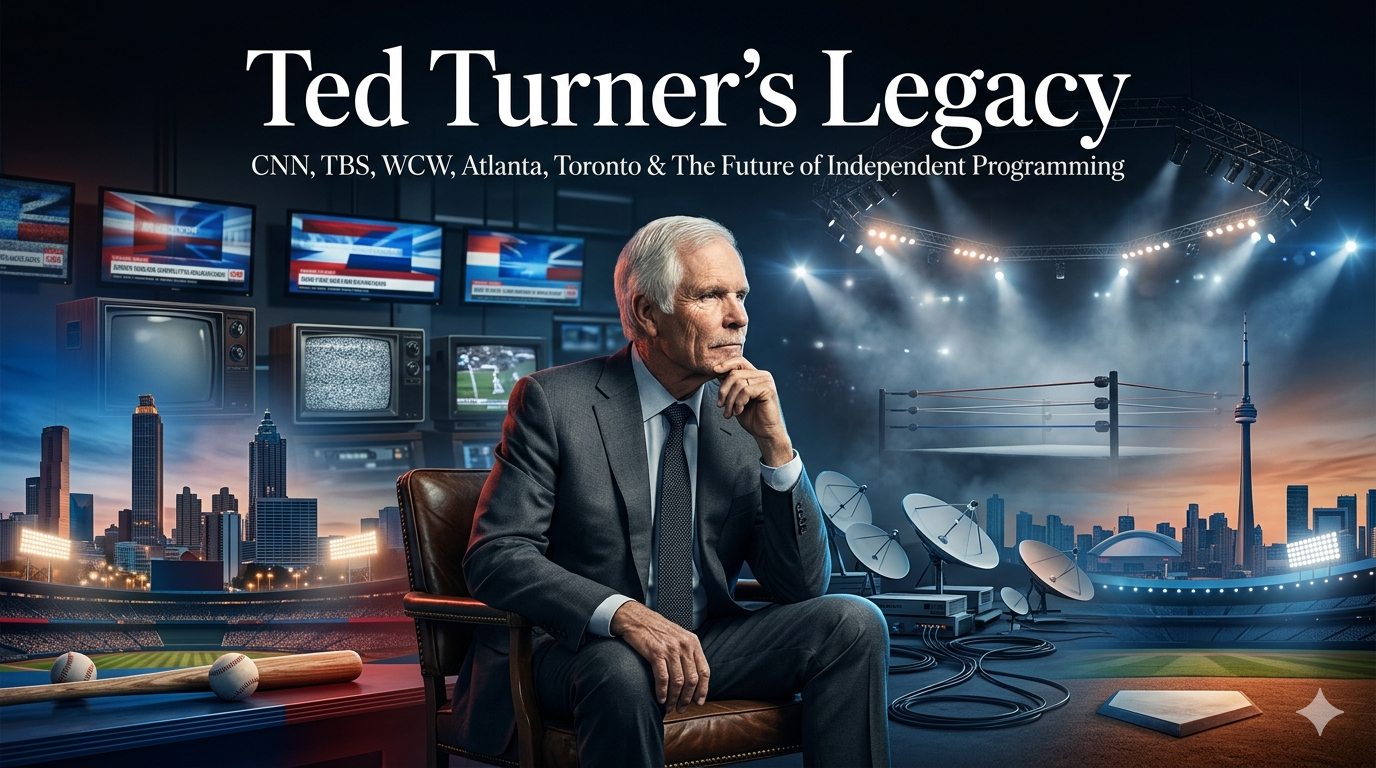
Ted Turner Dies At 87: CNN, TBS, Braves, WCW & Toronto Legacy
Ted Turner Dies At 87: How CNN, TBS, The Braves, WCW, And Toronto Helped Shape Modern Television
Ted Turner, the legendary founder of CNN and one of the most important figures in cable television history, has died at the age of 87.
Turner’s death marks the end of a chapter that changed how the world watches news, sports, entertainment, and live programming. Long before streaming, YouTube channels, digital media brands, and independent programmers became part of everyday life, Turner saw cable television as more than a secondary option. He saw it as the future.
That vision changed everything.
Turner launched CNN in 1980, creating the first 24-hour global news network and challenging the old television model dominated by the major broadcast networks. He also built TBS into a national superstation, helping prove that a channel with a clear identity could reach viewers far beyond one local market. Turner Enterprises notes that Turner purchased the Atlanta Braves in 1976, launched TBS Superstation, and later launched CNN as the world’s first live 24-hour global news network.
Ted Turner, the billionaire media entrepreneur and philanthropist who launched the 24-hour cable TV news revolution when he founded CNN in 1980, has died. He was 87. https://t.co/61G2Kuh8Vz pic.twitter.com/SqGmFOE48R
— CNN Breaking News (@cnnbrk) May 6, 2026
Atlanta Became A National Media City
Turner’s rise also made Atlanta a national media capital.
Through TBS, CNN, TNT, Cartoon Network, Turner Classic Movies, and sports broadcasting, Turner helped place Atlanta at the center of American television. CNN made Atlanta a global news hub. TBS made Atlanta entertainment available across the country. The Braves made Atlanta baseball a national brand.
Turner did not simply own the Atlanta Braves. He used TBS to turn Braves baseball into appointment television across America. AP noted that Turner’s decision to broadcast Braves games nationally through the TBS superstation expanded the team’s fanbase and helped reshape sports broadcasting.
That part of the story matters to WorldWide Entertainment TV because WWETV’s own media identity has always carried a Toronto-to-Atlanta connection. Atlanta represents entertainment infrastructure, Black music history, Southern hip-hop, television production, and independent media opportunity. Toronto represents Caribbean culture, Canadian hip-hop history, multicultural storytelling, and WWETV’s original foundation.
Turner’s career sits right at that intersection: local roots turned into national programming.
The Braves And Blue Jays Connected Atlanta And Toronto On A World Stage
I grew up watching the @braves and @ATLHawks on TBS thanks to Ted Turner, and worked in the promotions department of the Braves years later. So many memories thanks to his visionary leadership. Thank you Ted. https://t.co/QfOJ8e5JGG
— JeffHenderson (@JeffHenderson) May 6, 2026
The Atlanta–Toronto connection became even more historic in baseball.
In 1992, the Toronto Blue Jays defeated the Atlanta Braves in the World Series, bringing the championship north of the border for the first time. The National Baseball Hall of Fame describes Game 6 as Toronto’s 4-3 win over the Braves at Atlanta-Fulton County Stadium, with Dave Winfield’s 11th-inning double helping secure the victory.
That moment connected Turner’s Atlanta Braves era with Toronto sports history forever.
The Braves had become a national cable brand through Turner’s TBS machine. The Blue Jays became the first Canadian team to win the World Series. One side represented Atlanta’s rise as a television-powered sports city. The other represented Toronto stepping onto the global baseball stage.
For WWETV, that connection is more than trivia. It reflects the same two-city energy that runs through the platform today: Toronto roots, Atlanta entertainment ties, and a media lane that understands culture across borders.
WCW, Atlanta, And The War With WWE
Ted Turner saved Jim Crockett Promotions out of financial trouble and turned it into WCW. Eventually becoming major competition to WWE.
I can also imagine today that Ted Turner’s dealing with Time Warner in 1999 is similar to how Triple H and WWE are dealing with TKO right now.— Alexander Neal (@AJNBOILERUP) May 6, 2026
Turner’s impact on professional wrestling was just as important.
Through Turner Broadcasting, World Championship Wrestling became one of the biggest wrestling companies in the world. WCW’s identity was deeply tied to Atlanta and Turner television. With Monday Nitro on TNT, WCW went head-to-head with WWE’s Monday Night Raw, creating the famous Monday Night War of the 1990s.
WWE’s own history credits WCW with defeating Raw in the ratings for 84 consecutive weeks during the peak of that rivalry.
That war changed wrestling television. WCW forced WWE to evolve. The competition helped produce the Attitude Era, the rise of the nWo, Goldberg, Sting, D-Generation X, Stone Cold Steve Austin, The Rock, and a style of television that mixed sports, drama, controversy, live crowd energy, and pop culture.
Turner understood that programming had to feel urgent. Viewers needed a reason to tune in live, come back weekly, and feel like something could happen at any moment.
That lesson still matters today.
Toronto Had Its Own Wrestling Power Connection Through Jack Tunney
The wrestling story also has a Toronto chapter.
Before WWE became the global machine it is today, Toronto was one of North America’s great wrestling cities through Maple Leaf Wrestling and Maple Leaf Gardens. Jack Tunney, the longtime Toronto promoter, became known to millions of fans as the on-screen WWF President during the Hulkamania era.
Slam Wrestling’s history of the Tunney family notes that Jack Tunney aligned with Vince McMahon’s WWF in July 1984, positioning himself as Canada’s WWF promoter during the company’s national expansion.
That means the Turner/WCW and WWE rivalry was not only an Atlanta story. It also had a Toronto connection. WCW’s rise came through Turner’s Atlanta-based cable empire, while WWE’s Canadian expansion had roots in Toronto through Tunney and the Maple Leaf Wrestling territory.
For WWETV, that is a powerful cultural bridge: Atlanta helped fuel the WCW side of wrestling television, while Toronto helped anchor WWE’s Canadian connection.
From Cable Empires To Independent Programmers
Turner’s model was massive, commercial, and corporate. But the ripple effect of his vision helped create the media environment that independent programmers operate in today.
He proved that television did not have to be controlled by only three major networks. He proved that a channel could build its own identity. He proved that sports, news, movies, wrestling, and niche programming could create loyal audiences if distributed consistently.
That paved the way for today’s media world, where independent programmers can build across cable access, YouTube, digital platforms, community television, podcasts, and streaming.
That is where WorldWide Entertainment TV fits into the larger story.
WWETV’s programming on platforms such as BRIC TV, Brooklyn Free Speech, and Manhattan Neighborhood Network continues the broader idea that television can make room for independent voices. BRIC describes Brooklyn Free Speech as a community-produced nonprofit TV network where creators own the media they produce, while MNN describes itself as a media learning, production, and distribution hub for independent voices and community engagement.
The scale is different from Turner Broadcasting, but the principle connects.
Turner opened the door for more channels. More channels opened the door for more specialized programming. Specialized programming opened the door for independent creators, cultural historians, local storytellers, interviewers, and community-based media outlets to serve audiences overlooked by mainstream television.
Why Ted Turner’s Legacy Still Matters To WWETV
Ted Turner’s legacy is not only CNN. It is not only TBS. It is not only the Atlanta Braves or WCW.
His legacy is the belief that programming can change culture.
He took Atlanta media national. He used sports as programming. He made news continuous. He gave wrestling a major television war. He helped prove that viewers would follow bold alternatives when those alternatives had identity, consistency, and energy.
That lesson is still alive in the work of independent programmers today.
For WorldWide Entertainment TV, the connection is clear. WWETV operates from a Toronto-rooted cultural perspective while building bridges into New York, Atlanta, Brooklyn, Manhattan, hip-hop history, Black entertainment, interviews, archive programming, and community television.
Turner’s career showed that a programmer with vision can turn a local platform into something much larger.
From Atlanta’s Braves and WCW to Toronto’s Blue Jays and Jack Tunney wrestling history, the story runs through the same idea: cities build culture, television carries it, and independent programmers keep it alive for the next generation.
Ted Turner changed television by refusing to accept the limits of the old system.
That is why his legacy still matters.
Share this content:








Post Comment