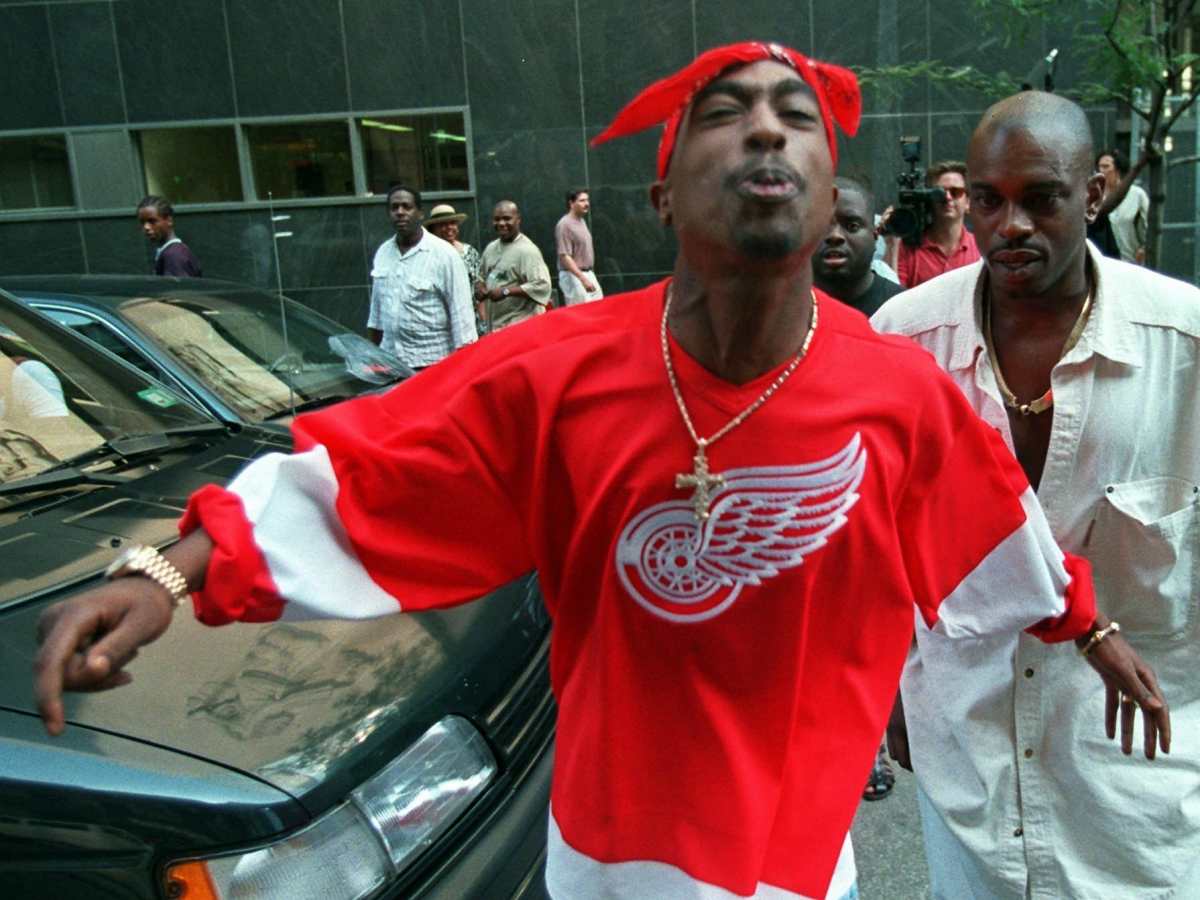
Mopreme Shakur Reveals Thug Life Code & Shakur Family Legacy
Mopreme Shakur is reclaiming the history behind Thug Life.
In an exclusive WorldWide Entertainment TV Tupac Files interview, Tupac Shakur’s brother speaks about their family, the principles behind the Thug Life movement, Mutulu Shakur’s influence and the community work that was often overshadowed by controversy.
For audiences who only understood Thug Life as the name of Tupac’s rap group or the famous tattoo across his stomach, Mopreme offers a more expansive account. In his telling, it represented a movement—one shaped by family responsibility, community organization and an effort to establish rules within an environment where formal systems had failed many young people.
The conversation also explores Mopreme’s forthcoming book, This Thug’s Life, and the personal experiences that made him a direct witness to one of hip-hop’s most influential families.
Watch the full WWETV exclusive interview below.
Mopreme Shakur remembers discovering Tupac was his brother
One of the interview’s most personal revelations comes when Mopreme recalls that, as a young child, he did not initially know Tupac was his brother.
Mopreme explains that he was approximately five or six years old when he discovered their relationship. Rather than presenting their bond only through the mythology that later surrounded Tupac, he remembers the excitement of a child learning that he had a brother.
That early memory introduces a side of the Shakur story that is easily lost when the family is discussed exclusively through fame, political struggle and tragedy.
Before Tupac became one of the world’s most recognizable artists, he was part of a family whose members were separated by circumstances but connected through a shared history. Mopreme’s recollections reposition Tupac as a brother and family member—not merely the cultural symbol the public came to know.
The two would eventually record together. Mopreme, then known as Wycked, appeared on Tupac’s 1993 song “Papa’z Song” and later became a member of the group Thug Life.
Mutulu Shakur’s influence on the family
View this post on Instagram
Mopreme also discusses the influence of his father, Mutulu Shakur, whose political beliefs and community work helped shape the family’s worldview.
Mutulu was known as a Black liberation activist and an advocate of acupuncture-based drug treatment. To Mopreme, however, his importance cannot be reduced to the criminal cases and political labels that followed him.
The interview presents Mutulu as a father, teacher and healer whose ideas about accountability and community survival became part of the foundation surrounding Tupac and Mopreme.
That distinction is important to understanding the Shakur family. Their political consciousness did not begin after Tupac became famous. It was already embedded in the family’s experiences, conversations and relationships.
Mopreme’s account suggests that Tupac’s desire to use his success to help others was connected to a much larger family tradition. Music provided the platform, but the underlying concerns—poverty, violence, fractured families and neglected communities—existed long before the fame.
Roy Wilkins Park and an overlooked Thug Life blueprint
The WWETV interview revisits Tupac’s appearance at Roy Wilkins Park in Jamaica, Queens, in 1994.
During that period, Tupac spoke about successful artists giving something back to the communities that supported them. His vision extended beyond charity or occasional public appearances. He discussed bringing artists, resources and economic participation back into underserved neighbourhoods.
That archival moment provides an important receipt for Mopreme’s explanation of Thug Life.
The movement was not intended to glorify destruction without limits. Behind the music and imagery was an attempt to create structure among people who often felt abandoned by conventional institutions.
From WWETV’s editorial perspective, this is where Thug Life can be understood as a form of community infrastructure rather than simply an aesthetic. Mopreme describes the movement itself; the “infrastructure” framing reflects the larger pattern visible across Tupac’s public statements, the Code of Thug Life and the Shakur family’s work.
What the Code of Thug Life was designed to do
The Code of Thug Life remains one of the most misunderstood parts of Tupac’s legacy.
Developed with input from Mutulu Shakur and other figures connected to the streets and Black liberation movement, the Code attempted to establish boundaries governing conduct within the drug trade and street economy.
Its provisions were intended to protect children, families and uninvolved community members while discouraging indiscriminate violence. The existence of the Code did not erase the dangers or contradictions of street life, but it demonstrated that “Thug Life” was not supposed to mean lawlessness without accountability.
Mopreme’s explanation challenges the way the term was frequently presented by mainstream media during Tupac’s lifetime.
To many outside observers, Thug Life appeared to be a celebration of criminality. Within Mopreme’s account, it was an effort to redirect people who were already living under dangerous conditions toward a shared standard of conduct and responsibility.
This does not require audiences to romanticize those conditions. It requires acknowledging that the people behind the movement believed they were responding to a crisis that already existed.
Thug Life was bigger than one rap group
Tupac, Mopreme, Big Syke, Macadoshis and The Rated R became known collectively as the rap group Thug Life. Their 1994 album, Thug Life: Volume 1, helped establish the name in hip-hop history.
Mopreme makes clear, however, that the idea was never confined to the group’s lineup.
“Thug Life was always bigger than just one group,” he explains in the WWETV conversation. “It was a movement.”
That distinction is central to the interview.
The group was one expression of Thug Life, but the philosophy was intended to extend into the community. Tupac’s music gave the movement visibility, while the Code and the family’s organizing principles supplied its deeper purpose.
Once the phrase was absorbed into popular culture, much of that context disappeared. The tattoo, defiant public image and controversies became easier to market than the community principles behind them.
Mopreme’s testimony restores that missing layer.
Tupac, Stretch and the human stories behind hip-hop history
Mopreme also reflects on Tupac’s relationship with Stretch, the rapper and producer who was once one of his brother’s closest collaborators.
Before suspicion and conflict fractured their relationship, Tupac and Stretch shared music, friendship and formative experiences. Mopreme’s memories—including a story involving Tupac and a missing tooth—bring humour and humanity into a history often dominated by violence and conspiracy.
Those stories matter because they show the people behind the headlines.
Tupac’s life has been examined through documentaries, books, court cases and competing theories. Mopreme’s perspective comes from inside the family and from someone who witnessed the relationships before they became pieces of hip-hop mythology.
The interview does not erase the later tensions. Instead, it preserves memories of brotherhood, creativity and ordinary moments that existed before tragedy changed how the story would be told.
Family loss and the responsibility to preserve the legacy
The Shakur family’s history is filled with achievement, activism and devastating loss.
Tupac was killed in 1996 at the age of 25. Afeni Shakur, whose determination transformed Tupac’s unfinished work into a protected global legacy, died in 2016. Mutulu Shakur died in 2023 after receiving compassionate release from federal prison.
Mopreme has therefore inherited more than a famous surname. He carries the responsibility of explaining a family history that has repeatedly been interpreted by outsiders.
In the interview, that responsibility is connected to This Thug’s Life. The book gives Mopreme space to tell his own story while documenting experiences that cannot be fully understood through Tupac alone.
His perspective also complicates the public’s image of the Shakur family. Their history includes music and militancy, but also healing, education, community programs, family bonds and repeated attempts to build something constructive from pain.
The work continued after Tupac’s death
Afeni Shakur’s creation of the Tupac Amaru Shakur Foundation and the Tupac Amaru Shakur Center for the Arts demonstrated that the family’s mission did not end with Tupac’s death.
The arts center in Stone Mountain, Georgia, gave young people access to creative education and an environment in which their talent could be developed. It represented many of the principles Tupac had discussed publicly: returning resources to the community, developing future artists and creating opportunities that had not previously existed.
For WWETV, the center also holds a direct connection to the company’s history. WorldWide Entertainment TV previously covered activities associated with the Tupac Shakur Center, making Mopreme’s interview part of an ongoing effort to preserve the family’s cultural work alongside the more familiar headlines.
That history reinforces the central argument of the conversation: Tupac’s legacy is not complete if it is limited to record sales, controversy or the unresolved circumstances surrounding his death.
Mopreme Shakur calls for understanding and reconciliation
Mopreme’s message is ultimately directed toward the next generation.
The interview asks viewers to look beyond the simplified meaning attached to the word “thug” and examine the social conditions the movement was attempting to address. It also raises questions about truth, reconciliation and the responsibility to learn from the losses that shaped hip-hop’s history.
Nearly three decades after Tupac’s death, the public remains fascinated by what happened to him. Mopreme’s perspective reminds audiences to also ask what Tupac and his family were attempting to build while he was alive.
Thug Life became a rap group, an album title, a tattoo and one of the most recognizable phrases in popular culture. According to Mopreme, it was also something larger: a movement intended to give people identity, rules and responsibility within communities struggling to survive.
That is the history at the center of WWETV’s latest Tupac Files interview.
Share this content:








Post Comment