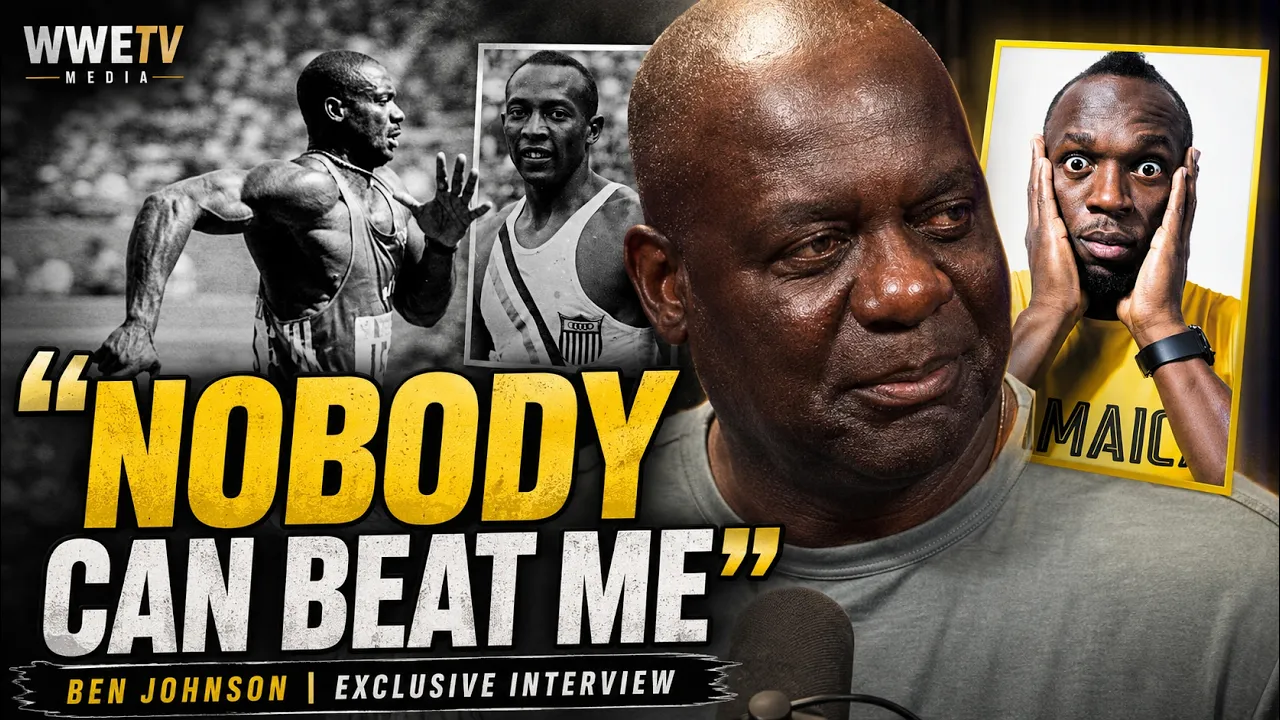
Ben Johnson Says Nobody Could Run Him Down In Usain Bolt Comparison
Ben Johnson Says Nobody Could Run Him Down: Why Usain Bolt Comparisons Still Follow Sprinting’s Most Controversial Legacy
Ben Johnson and Usain Bolt are rarely mentioned in the same sentence without controversy entering the conversation. One became the most celebrated sprinter of the modern era. The other became one of the most debated figures in Olympic history.
But in a new WorldWide Entertainment TV Media Short, Johnson brings the conversation back to the track itself. Speaking in his exclusive WWETV interview, Johnson says that in his prime, nobody could run him down.
That statement opens a bigger question than a simple “Ben Johnson versus Usain Bolt” debate.
It asks how sprinting history remembers power, speed, scandal, and legacy.
Ben Johnson’s Claim Is About More Than Speed
When Ben Johnson says nobody could run him down, he is talking about the way he ran.
Johnson’s sprinting identity was built on explosiveness. His start, acceleration, drive phase, and early-race power made him one of the most intimidating sprinters of the 1980s. In the public imagination, his race was often decided before other runners had fully settled into their rhythm.
That is why Johnson’s comparison to Usain Bolt is so interesting.
Bolt’s greatness was different. Bolt was famous for his tall frame, relaxed stride, and devastating top-end speed. If Johnson’s image was the explosion from the blocks, Bolt’s image was the long, smooth takeover in the second half of the race.
One was remembered for the start.
The other was remembered for the finish.
That contrast is why the comparison still gets people talking.
The Record Book Tells One Story
The official record book belongs to Usain Bolt.
Bolt’s 9.58-second world record in the 100 meters, set at the 2009 World Championships in Berlin, remains the standard for the event. World Athletics lists Bolt as the current 100-meter world record holder with that 9.58 mark from August 16, 2009.
Bolt also owns one of the most iconic Olympic sprinting runs ever. At London 2012, he won the 100 meters in 9.63 seconds, setting a new Olympic record and confirming his status as the dominant sprinter of his era.
Ben Johnson’s official story is more complicated. At the 1988 Seoul Olympics, Johnson crossed the line first in the men’s 100 meters in 9.79 seconds, but he was later disqualified after testing positive for a banned substance. Carl Lewis was awarded the gold medal, and Johnson’s record was removed.
So if the question is only about official records, Bolt stands alone.
But WWETV’s interview is not only about the record book.
It is about legacy.
Why The Comparison Still Matters
The reason Ben Johnson and Usain Bolt comparisons continue is because both men changed how people looked at sprinting.
Bolt made sprinting joyful, global, marketable, and almost theatrical. His dominance was celebrated with personality, showmanship, and the image of a man who could slow down, smile, and still win.
Johnson’s dominance had a different emotional effect. Before the scandal consumed his story, he represented raw force. He looked like a sprinter engineered for the first half of the race — compact, powerful, direct, and impossible to ignore.
That is the point of Johnson’s “nobody could run me down” statement.
He is not simply claiming a fantasy race against Bolt.
He is arguing that his prime had a specific kind of sprinting power that should not be erased from the conversation.
Start Versus Finish
The cleanest way to understand the comparison is this:
Ben Johnson was the danger early.
Usain Bolt was the danger late.
Johnson’s reputation was built around the ability to get out fast, apply pressure immediately, and make the rest of the field chase.
Bolt’s reputation was built around the opposite kind of fear. Even if another runner started well, Bolt could rise into his stride, open up, and make the final 40 meters look like a different race.
That is why fans still debate the hypothetical.
Could Johnson’s explosive start put pressure on Bolt early?
Could Bolt’s top-end speed erase that advantage late?
Would the race be decided in the first 30 meters or the final 30?
There is no official answer, because the two men came from different eras, different conditions, and radically different public narratives.
But that is exactly why the debate works.
The WWETV Angle: Who Gets To Control The Story?
Johnson’s career is one of the clearest examples of how one moment can swallow an entire athletic identity.
For decades, the public version of Ben Johnson has been reduced to Seoul 1988. The scandal became the headline. The disqualification became the legacy. The debate over what was happening across sprinting during that era often became secondary.
Bolt’s legacy moved in the opposite direction. He became the face of modern sprinting greatness: the world record holder, the Olympic showman, the global icon.
That does not mean the two stories should be treated as equal. Bolt’s official achievements are unmatched. Johnson’s record was removed. Those facts matter.
But WWETV’s exclusive interview gives Johnson space to explain how he views his own athletic peak.
That is the value of the Short.
It lets the man at the center of one of sprinting’s most famous controversies speak about the part of the story that often gets lost: how it felt to be that fast, that powerful, and that feared before history narrowed the frame.
Past, Present, Future
WWETV’s broader Ben Johnson rollout has connected Johnson to a larger sprinting timeline: Jesse Owens, Ben Johnson, and Usain Bolt.
Owens represents the past — an Olympic legend whose story became wrapped in history, race, politics, and myth.
Johnson represents the controversy — a sprinter whose performance shocked the world before the scandal changed everything.
Bolt represents the future — the modern global sprinting icon whose records and personality turned the 100 meters into a worldwide stage.
Together, they show how sprinting is never just about time.
It is about who gets celebrated, who gets questioned, who gets protected, and who gets reduced to one moment.
Why This Short Matters Now
The new WWETV Media Short is not trying to rewrite the official record book.
It is doing something different.
It is reopening the conversation around how Ben Johnson sees his own prime, how fans compare eras, and why Usain Bolt’s name still becomes part of the debate whenever sprinting greatness is discussed.
Johnson saying nobody could run him down is the kind of line that forces a reaction.
Some viewers will disagree immediately.
Some will bring up Bolt’s 9.58.
Some will bring up Seoul.
Some will remember how terrifying Johnson looked in full flight.
That is why the clip works.
It is not just nostalgia.
It is Culture Court for sports history.
Was Ben Johnson simply one disqualified race?
Or was he part of a sprinting blueprint that still shapes how fans talk about power, speed, and legacy?
That is the debate WWETV is putting back on the track.
Share this content:













Post Comment