Marla Gibbs Responds to WWETV’s Hal Williams Tribute
Marla Gibbs Responds to WWETV’s Hal Williams Tribute—And the Story Behind Lester Jenkins
After the passing of Hal Williams at 91, his longtime 227 co-star acknowledged WWETV’s memorial Reel—opening a deeper conversation about the Black television father Marla Gibbs fought to place onscreen.
Marla Gibbs has acknowledged WorldWide Entertainment TV’s Instagram tribute to Hal Williams, her longtime television husband on the classic NBC sitcom 227.
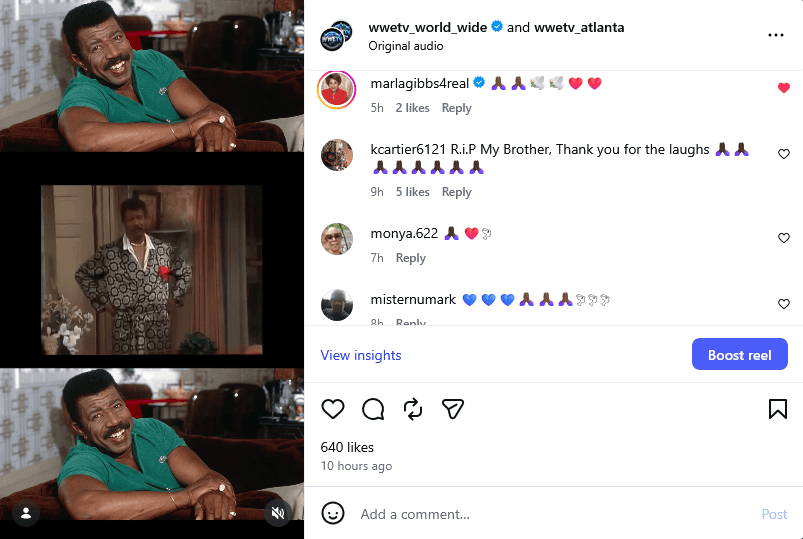
The verified account of the legendary actress responded to the WWETV Reel with prayer hands, doves and heart emojis—a quiet but meaningful acknowledgment as viewers, colleagues and television fans continue remembering Williams following his death at age 91.
WWETV replied by extending condolences to Gibbs and Williams’ family and thanking the actress for the memories created through their work together.
The interaction arrives as the original WWETV Studios tribute, “Hal Williams Made Black TV Feel Like Home,” continues connecting with viewers who remember Williams as both Officer “Smitty” Smith on Sanford and Son and Lester Jenkins on 227.
But the story behind Lester carries an even deeper meaning.
Lester Jenkins was not simply another sitcom father
View this post on Instagram
Before Williams became the dependable husband and father at the center of the Jenkins household, he was already familiar to television viewers.
During the 1970s, Williams appeared as Officer Smitty on Sanford and Son. Paired with Howard Platt’s Officer Hoppy, Smitty frequently understood Fred Sanford and the Black community surrounding him better than his partner did.
The role made Williams a recognizable part of one of the most influential Black sitcoms in television history. More than a decade later, however, 227 allowed audiences to see him differently.
As Lester Jenkins, Williams became the hardworking husband of Mary Jenkins, played by Gibbs, and the father of Brenda Jenkins, played by a young Regina King.
Lester was rarely the loudest person in the room. Mary, Sandra Clark and the other residents of the apartment building frequently generated the show’s biggest confrontations and comedic moments. Lester provided something equally important: stability.
He represented a present Black husband and father whose place within the family did not need to be treated as extraordinary.
Marla Gibbs pushed for a husband and father on 227
According to Gibbs’ accounts of the show’s development, the television adaptation of 227 initially presented Mary Jenkins as a single woman. Gibbs objected to that direction and made it clear that she wanted Mary to have a husband.
Her position helped create the family structure that audiences ultimately saw, with Williams cast as Lester and King as their daughter, Brenda.
The distinction is important. Gibbs did not merely perform the role she was handed. As the star and a producer of 227, she helped shape the images the program would place before millions of viewers.
The result was one of the most recognizable Black families of 1980s television.
Williams later described 227 as a family show that people could watch “across all color lines.” The series ran for five seasons on NBC, from 1985 until 1990, and helped launch Regina King’s television career.
Gibbs has remained close to members of the 227 family. Speaking about King in a recent interview, she explained that their onscreen connection felt real: King felt like her daughter, and Gibbs treated her accordingly.
The stand echoed Esther Rolle and Good Times
Gibbs’ insistence on giving Mary Jenkins a husband followed an important precedent established by Esther Rolle.
Before Good Times reached television in 1974, Rolle fought for Florida Evans to have a husband and for her children to have a father in the home. That demand helped make James Evans—portrayed by John Amos—a central part of the series.
James and Florida Evans became one of television’s most significant portrayals of a working-class Black couple. Despite economic hardship, the Evans household was initially presented as a two-parent family confronting its struggles together.
Rolle and Amos later challenged the direction of Good Times when they believed its storytelling was leaning too heavily into stereotypes. Amos was eventually removed from the series, and Rolle temporarily departed after James was killed off.
Their resistance demonstrated that Black performers were not only seeking visibility. They were fighting over what that visibility would communicate.
Years later, Gibbs protected a similar image on 227.
The circumstances were not identical, but the principle connected them: two major Black actresses used their influence to challenge the idea that a Black mother automatically needed to be portrayed without a husband or father beside her.
Because they spoke up, audiences received James Evans and Lester Jenkins.
From Smitty to Lester
The contrast between Williams’ two signature characters demonstrates the range of his television legacy.
Officer Smitty made audiences laugh while helping Sanford and Son communicate cultural jokes that might otherwise have been lost. Lester Jenkins offered a different kind of representation—a steady father, husband and provider positioned at the center of a loving Black family.
Williams understood that his function in comedy was often to ground the people around him.
“I wasn’t the funny guy,” he once explained when discussing being typecast through his sitcom work. “I was the straight guy in all the madness.”
That quality made Lester work. Williams did not need exaggerated speeches or constant punchlines to establish the character’s importance. His presence helped make the Jenkins household feel complete.
Marla Gibbs’ response adds a living connection
Gibbs did not issue a lengthy statement beneath WWETV’s post. Her response was communicated through symbols of prayer, peace and love.
It should not be overstated or treated as an endorsement of every point in the Reel. It was an acknowledgment from the woman who spent five seasons portraying Williams’ television wife.
That acknowledgment connects the memory audiences retain from 227 with the real people who created it.
Hal Williams’ passing is not only the loss of a familiar actor. It closes another chapter connected to the generation that helped define Black family life on American television.
Officer Smitty made viewers laugh.
Lester Jenkins helped make Black television feel like home.
And behind that character was Marla Gibbs—an actress and producer who understood that representation was not simply about being seen. It was about deciding what audiences would see when Black families entered their homes every week.
Share this content:










Post Comment