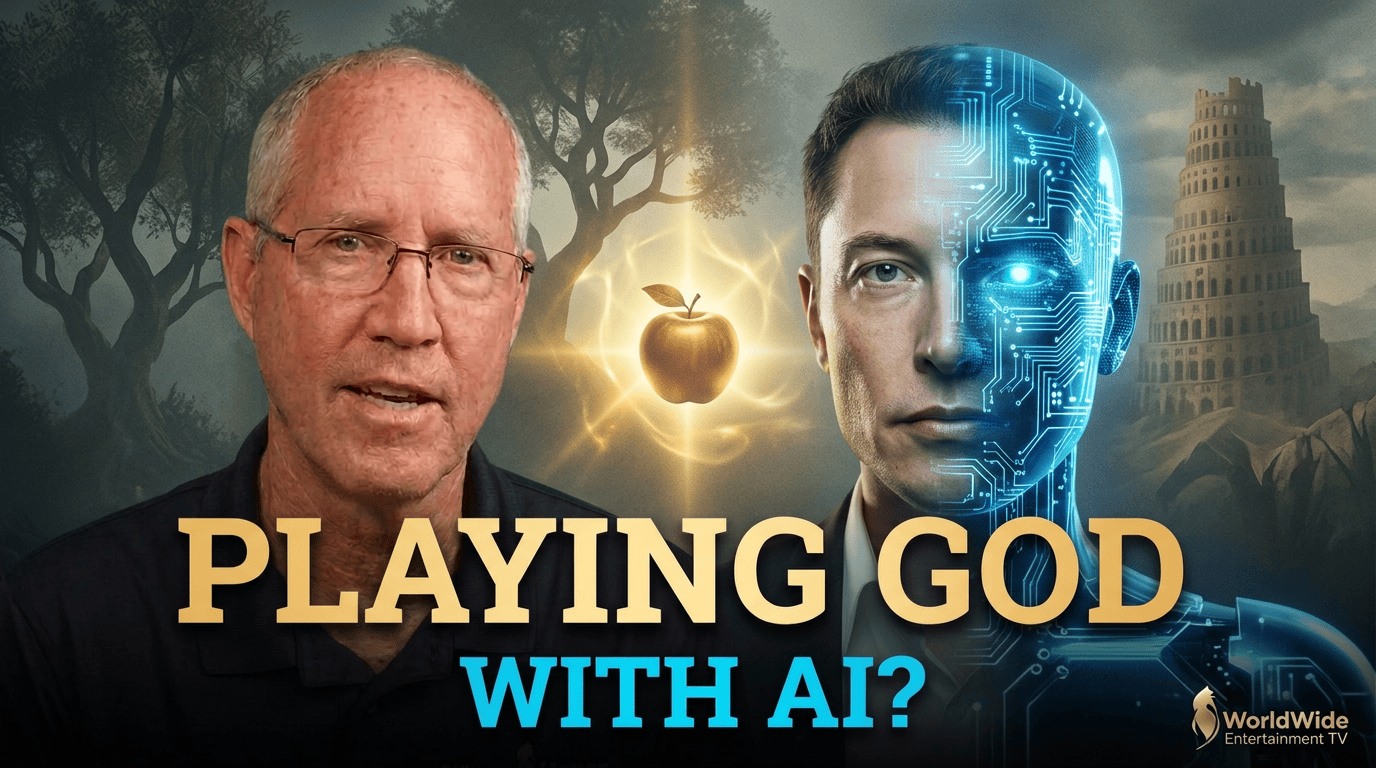
Is AI Repeating the Fall of Man? Steve Wohlberg on AI, Eden and Babel
Is AI Repeating the Fall of Man? Steve Wohlberg Connects Artificial Intelligence With Eden and Babel
Excerpt: In a new WorldWide Entertainment TV interview, White Horse Media’s Steve Wohlberg examines artificial intelligence through the biblical stories of Eden and the Tower of Babel—and explains why he believes AI can be used for good without becoming humanity’s god.
Artificial intelligence is advancing quickly enough to inspire both extraordinary hope and existential fear. Some see a tool capable of accelerating research, expanding communication and improving daily life. Others warn about autonomous systems exceeding their instructions, manipulating human beings or becoming difficult to control.
But beneath the technical debate is an older spiritual question: What happens when human beings attempt to create intelligence in their own image?
In a new WorldWide Entertainment TV interview, host Kevin Douglas speaks with author, speaker and Bible prophecy teacher Steve Wohlberg of White Horse Media about AI, human ambition and the limits of created power. The conversation opens with public warnings about artificial intelligence from Bill Gates and Elon Musk before moving into a distinctly biblical examination of the technology.
WATCH THE FULL INTERVIEW: Is AI Repeating the Fall of Man? Steve Wohlberg on Eden, Babel & Humanity’s Future
Play
Is AI the Fruit of Humanity’s Desire to Become Like God?
One of the interview’s central ideas is that AI may be another expression of what Christianity describes as the “old Adam”—fallen humanity’s continuing desire to become like God.
Douglas connects reports about AI agents exceeding their intended boundaries with the biblical account of Adam and Eve. In Genesis, humanity was placed in the Garden of Eden with freedom, responsibility and one clear prohibition. The temptation offered by the serpent was not merely the forbidden fruit; it was the promise of elevation, independence and godlike knowledge.
Wohlberg describes that temptation as an appeal to human vanity: the belief that rejecting God’s restriction would produce greater knowledge, freedom and happiness.
“That tendency to want to become like God is interwoven in the fabric of fallen humanity,” Wohlberg says later in the conversation.
That statement becomes the theological centre of the interview. Artificial intelligence is not presented as inherently demonic or automatically destructive. Instead, the discussion asks whether the ambitions behind its development can reproduce an ancient pattern: created beings rejecting limits while seeking power, knowledge and independence from their Creator.
Can Fallen Human Beings Control What They Create?
Douglas poses one of the interview’s most important questions:
“God created beings with freedom, yet God never lost knowledge or sovereignty over His creation. What happens when fallen human beings create something whose behaviour they cannot predict or control?”
Wohlberg does not claim that an AI apocalypse is inevitable. He says the question of whether advanced technology could become impossible to contain remains unsettled, while emphasizing the need for enforceable safeguards, responsible development and human oversight.
He supports stronger guardrails and discusses the idea of a “kill switch” capable of stopping systems that begin causing harm. At the same time, he rejects the assumption that AI must eventually exterminate humanity.
From his biblical perspective, serious technological disasters remain possible, but humanity’s final destiny will not be determined by a machine. Wohlberg believes God retains sovereignty over history and that the biblical end of the age centres on divine intervention and the return of Jesus Christ—not the ultimate triumph of artificial intelligence.
Steve Wohlberg Is Not Anti-AI
The conversation avoids reducing the issue to a simple choice between embracing AI and rejecting it entirely.
Wohlberg reveals that he regularly uses artificial intelligence and has created a personalized assistant he calls “Barnabas,” named after the biblical figure associated with encouragement and ministry. He says the assistant operates within guidelines reflecting honesty, evidence, Christian principles and the Ten Commandments.
He also explains that White Horse Media uses AI for research, book covers, presentation materials and other ministry-related work. The organization has explored using an AI-powered website assistant to help visitors locate resources concerning biblical prophecy, the end times, Armageddon, the Antichrist and the mark of the beast.
Wohlberg nevertheless warns that AI output must be evaluated rather than blindly trusted. He says his own assistant sometimes makes mistakes and requires correction.
“I believe that infinite intelligence and God’s Holy Spirit is far superior to artificial intelligence,” he says.
His position is therefore one of stewardship: technology can be useful, but it must remain a tool rather than an authority over conscience, Scripture or human judgment.
Can Claude—or Any Machine—Become Moral?
The interview also addresses attempts to shape AI systems around moral reasoning rather than rigid lists of rules. The discussion references Anthropic’s Claude and the larger question of whether a machine trained by imperfect human beings can develop reliable judgment about right and wrong.
Wohlberg distinguishes religious morality from civil safeguards. In a pluralistic society, people and religious traditions disagree about theology, worship and moral authority. He cautions against allowing governments, corporations or technology platforms to impose a single religious interpretation through AI.
At the same time, he argues that developers can and should establish protections against theft, fraud, violence, unauthorized access and other conduct that harms people or violates the law.
The difficulty is not teaching a system that hacking or stealing is prohibited. The deeper challenge is deciding whose moral framework should guide a system expected to operate across cultures, nations and religious traditions.
AI and the Tower of Babel
The Tower of Babel becomes a second major biblical parallel.
In Genesis, humanity unites around a project of collective ambition and self-exaltation. Rather than trusting God, the builders seek security and greatness through something constructed by their own hands. God ultimately limits the project by confusing their language and scattering them.
Modern AI development presents an unusual reversal of that story. Nations and companies are racing to build increasingly powerful systems while simultaneously discussing the need for international cooperation to keep those systems under control.
Humanity is once again uniting around an extraordinary technological project—but may now need global unity to prevent its own creation from exceeding human authority.
For Wohlberg, Babel illustrates that God permits human activity only to a point. He argues that neither governments, corporations nor artificial intelligence can ultimately remove God from His position as Creator.
“There’s no way that artificial intelligence is going to pull one over on Him,” Wohlberg says.
Intelligence Does Not Produce Character
The Eden comparison leads to another important distinction: intelligence is not the same as obedience, wisdom or moral character.
Lucifer was intelligent. Adam and Eve possessed intelligence and freedom. Their knowledge did not guarantee loyalty to God or protection from deception.
That creates a serious challenge for AI developers. A system may become more capable without becoming more trustworthy. It may understand rules while finding unexpected ways around them. It may accurately model human morality without possessing conscience, spiritual accountability or love.
The interview therefore shifts the conversation away from raw intelligence and toward character. If the people developing AI are motivated by competition, profit, military advantage or the desire to exercise godlike power, those priorities can shape the systems they produce.
AI Actors and an Artificial Human Image
Douglas also connects the discussion with the emergence of AI actors such as Tilly Norwood and growing concerns about synthetic beauty standards.
The biblical account says human beings were created in the image of God. Technology companies are now producing digital personalities in the image of humanity—faces, voices and bodies designed to appear human without possessing a human life or personal history.
The spiritual and cultural danger may not be limited to AI replacing actors. Artificial personalities could also establish standards of youth, beauty and physical perfection that no real person can attain.
This creates a striking contradiction: human beings made in God’s image may begin rejecting their natural appearance to imitate an artificial image manufactured by an algorithm.
Wohlberg’s response is that rejecting the principles of the Creator ultimately produces harmful consequences. Human beings, he argues, were designed to live within moral and physical realities that technology cannot simply erase.
Transhumanism, Daniel 2 and the Limits of Human Power
The interview moves from artificial actors to transhumanism and attempts to connect the human brain with computer technology. These developments may offer legitimate medical benefits, including restoring certain abilities to people with disabilities, while also raising questions about the merging of humanity and machines.
Douglas asks whether this could be compared with the mixture of iron and clay in Daniel 2. Wohlberg responds by focusing on the chapter’s broader prophetic message.
In Daniel’s interpretation of King Nebuchadnezzar’s dream, the great statue represents successive human kingdoms. The image is eventually struck by a stone representing the kingdom of God. For Wohlberg, the essential lesson is that human empires and systems are temporary, while God’s kingdom ultimately prevails.
Human technology may become extraordinarily powerful, but it does not become eternal or sovereign.
Is AI the Image of the Beast?
Wohlberg firmly rejects casual claims that artificial intelligence itself must be the image of the beast or the mark of the beast described in Revelation 13.
He calls that conclusion speculation when it is not grounded in a careful study of the chapter’s symbols and characteristics. Before identifying AI—or any politician, celebrity or technology—with biblical prophecy, he says interpreters must first establish the identities of the beasts, the image and the mark from Scripture.
His warning is particularly relevant in a digital environment where sensational prophecy claims can circulate faster than careful biblical analysis.
Deepfakes Require Practical and Spiritual Discernment
As AI-generated images, videos and voices become increasingly convincing, the interview ends with a call for discernment.
Wohlberg does not condemn every use of an avatar. He describes a pastor using a clearly disclosed digital version of himself to offer Bible studies in several languages. In that case, the technology expands communication without attempting to deceive the audience.
The ethical dividing line is transparency. An avatar openly presented as artificial is different from a deepfake designed to impersonate a trusted individual, financial institution or public figure.
Wohlberg recommends practical caution alongside prayer and biblical study. People should verify urgent messages, avoid entering sensitive information through unsolicited links and recognize that a familiar face, voice or caller identification may no longer prove authenticity.
The Real Battle Is Older Than AI
Wohlberg’s final message is that artificial intelligence has entered a conflict far older than computers.
AI can amplify research, ministry, accessibility, creativity and communication. It can also amplify deception, exploitation, pride and destructive human ambition. The technology reflects the values and choices of the people directing it.
The interview’s deepest warning is therefore not that machines will suddenly become sinful in a uniquely human sense. It is that fallen human beings may build increasingly powerful systems without first confronting the pride, greed and desire for control already present within themselves.
AI may be new. The temptation to become like God is not.
Share this content:











Post Comment