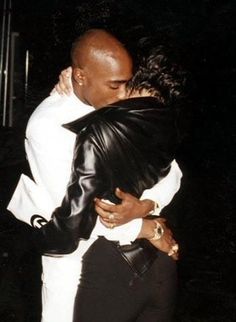
Tupac’s Wife And Fiancée Told Their Truth — Then Chose Privacy
Tupac’s Wife Keisha Morris And Fiancée Kidada Jones Chose Privacy
Today would have been Tupac Shakur’s birthday. Decades after his passing, his name still sparks emotion, debate, discovery, and endless retellings. But in the middle of all that noise, two women connected to Tupac’s most intimate chapters stand out for a different reason.
They did not keep retelling him.
Keisha Morris, Tupac’s legal wife, and Kidada Jones, the woman widely remembered from his final chapter and fiancée period, both had moments where they spoke about Tupac. But neither became a constant public voice turning his private life into a permanent headline cycle.
Almost 30 years later, that silence says something.
Keisha Morris Spoke Early To Correct The Record
Keisha Morris has long been reduced by some fans and commentators to one question: did Tupac marry her only because he was in prison?
That question is exactly why her early interviews still matter.
A resurfaced WWETV archive post from the old Wix site revisited Keisha’s Sister 2 Sister May 1997 interview, where she addressed the rumors around her marriage to Tupac. The interview made clear that Keisha wanted her relationship with Tupac recognized as real, not dismissed as a prison arrangement. The post also noted that Keisha and Tupac married on April 4, 1995, and divorced in 1996.
One of the most important parts of that archive is the way Keisha pushed back against the idea that their relationship was only about visits. In the interview, she said there were no conjugal visits and that Tupac did not want their marriage reduced to that assumption. She also explained that people believed Tupac married her because he was in jail, but she rejected that version of the story and said he had bought her a ring months earlier.
That matters because Keisha was not simply adding gossip to Tupac’s story. She was trying to correct a rumor that followed her name for decades.
Kidada Jones Represented Tupac’s Final Chapter
Kidada Jones is a different part of the story.
View this post on Instagram
She was not Tupac’s legal wife, but she has long been tied to his final months. Vanity Fair described Kidada as the woman wearing Tupac’s ring and reported that the two were discussing future plans before the Las Vegas shooting. The article framed her as part of a period where some around Tupac felt he was becoming freer and looser.
That relationship also carried a complicated backstory. People revisited how Tupac’s earlier comments about Quincy Jones led to conflict with Rashida Jones, before Tupac later apologized to Rashida, Quincy, and Kidada. According to People, Kidada later described Tupac as the love of her life in Quincy Jones’ autobiography and said they lived together for four months before he was killed.
Even Tupac’s jewelry became part of that history. Pitchfork reported that Sotheby’s auctioned a ring designed by Tupac that was meant to commemorate his engagement to Kidada Jones and included the inscription “Pac & Dada 1996.”
So while Keisha Morris represents the legal marriage chapter, Kidada Jones represents the final future-planning chapter.
And both women largely chose privacy.
The Silence Became Part Of The Story
Tupac’s legacy has become one of hip-hop’s biggest memory economies.
There are documentaries, biopics, books, interviews, podcasts, estate battles, anniversary tributes, social media debates, conspiracy theories, and endless commentary. People who knew Tupac for one night, one studio session, one hallway moment, or one industry encounter have sometimes become recurring voices in his public story.
That is why Keisha Morris and Kidada Jones feel different.
They had proximity, but they did not build their entire public identities around constantly retelling Tupac. They spoke when they chose to speak, and then largely stepped back.
That kind of restraint is rare now.
In today’s culture, every private memory can become content. Every relationship can become a clip. Every old photo can become a new headline. But Keisha and Kidada show another possibility: sometimes the people closest to the story do not need to keep proving they were there.
Their silence may be loyalty. It may be pain. It may be self-protection. It may be respect for Tupac’s legacy. It may be all of those things at once.
Maybe Tupac Trusted Women Who Understood Privacy
It is impossible to fully know why Tupac chose the women he chose. Only Tupac, Keisha, and Kidada could truly explain those private dynamics.
But it is hard not to notice a pattern.
Keisha Morris pushed back against being reduced to a rumor. Kidada Jones became part of Tupac’s final emotional chapter, but did not turn that role into constant public exposure.
Maybe Tupac, who lived so much of his life under pressure, controversy, surveillance, and performance, valued women who did not move like everyone else around fame.
Maybe part of what made Keisha and Kidada different was that they understood something the public often forgets: not every memory has to become public currency.
Tupac’s Music Made Him Immortal, But The Interviews Reveal The Man
On Tupac’s birthday, fans usually return to the music first. That makes sense. The songs are where the pain, poetry, anger, tenderness, and contradiction all live.
But interviews like Keisha Morris’ remind us that Tupac was also someone’s husband, someone’s partner, someone’s complicated love story, and someone who was still trying to figure out who he would become if he had more time.
Kidada Jones reminds us of the future that was being imagined before everything stopped.
Almost 30 years later, Tupac’s life is still debated by people who never met him. But the women closest to his wife and fiancée chapters have remained mostly quiet.
Maybe that silence is not absence.
Maybe it is the final form of protection.
Watch the Keisha Morris archive Short now on WWETV Media.
Share this content:











Post Comment