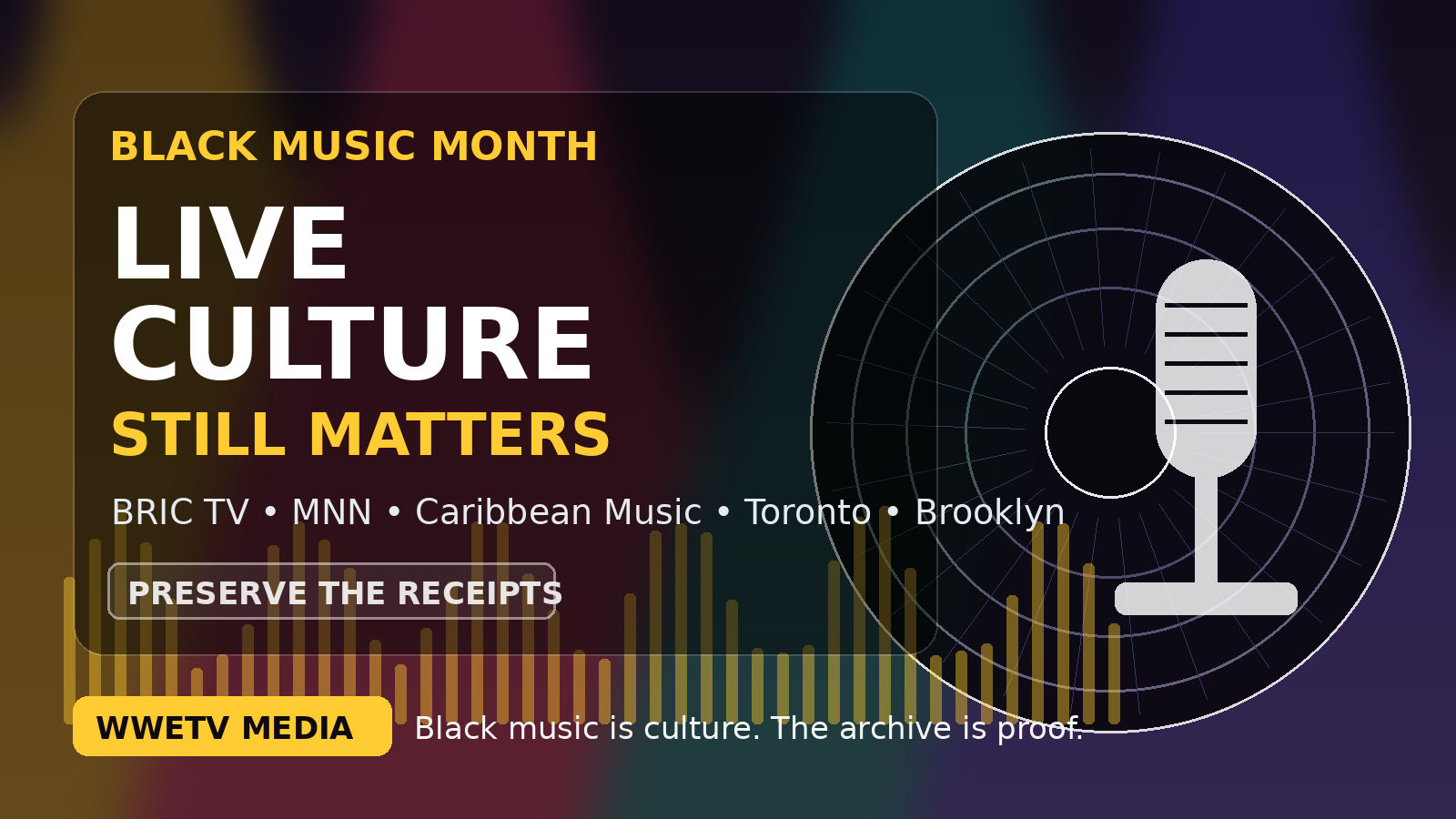
Black Music Month 2026: WWETV Celebrates Live Culture On BRIC TV
Black Music Month Begins With More Than A Playlist
Black Music Month is here, and every June the culture gets flooded with tributes, playlists, countdowns, and social media posts celebrating the artists who shaped generations.
But WorldWide Entertainment TV sees something deeper happening in 2026.
Black Music Month should not only be about remembering the songs. It should also be about preserving the spaces where the music lives: stages, community television, local festivals, interviews, archives, family memories, neighborhood stories, and independent cameras that captured moments before they became history.
That is why WWETV NY’s Sounds of June episode on BRIC TV and MNN arrives at the right time. It is not just a music episode. It is a reminder that live Black culture still matters.
Why Live Culture Still Matters
Streaming changed the way music travels. Social media changed the way artists build audiences. Viral clips can make a song move faster than radio ever did.
But live culture still proves something that numbers alone cannot.
When an artist steps on stage, when a crowd responds, when a city gathers, when a local camera documents it, the music becomes more than content. It becomes community memory.
That is the part Black Music Month must protect.
A playlist can remind people of a hit record. A live performance reminds people of how the music moved bodies in real time. An interview can reveal what the artist was thinking. A community broadcast can preserve a moment for people who were not in the room.
That is where WWETV’s role becomes clear: the archive is not just old footage. The archive is proof that the culture happened.
WWETV NY’s “Sounds Of June” Connects Caribbean Music, Toronto Culture, And New York Hip-Hop
WWETV NY’s June episode, Sounds of June, brings together a mix of Caribbean music, Toronto culture, New York hip-hop, and Black entertainment legacy.
The episode features Maxi Priest, Kevin Lyttle, Kreesha Turner, King Ajamu, and Bonnie Godiva, creating a lineup that reflects how Black music moves across borders, genres, and generations.
That combination matters.
Maxi Priest represents the global reach of reggae and lovers rock. Kevin Lyttle connects to the international rise of soca and Caribbean pop. Kreesha Turner brings a Toronto and Canadian R&B connection. King Ajamu reflects Grenadian soca culture and the power of Caribbean performance. Bonnie Godiva adds a Toronto battle rap and hip-hop media bridge.
Together, the episode tells a larger story: Black music is not one sound. It is a living network.
From Brooklyn To Toronto To The Caribbean
BRIC TV and MNN are important because community media gives independent culture a place to breathe.
Brooklyn has always been a crossroads for Caribbean music, hip-hop, dancehall, reggae, soul, and immigrant culture. Toronto has its own layered Black music history through Little Jamaica, Scarborough, Weston Road, dancehall, hip-hop, R&B, and Caribbean community influence.
WWETV’s strength is connecting those worlds.
A Maxi Priest performance is not just a reggae clip. It connects to Caribbean migration, Brooklyn stages, Toronto audiences, and the way reggae helped shape modern R&B and pop. A Kevin Lyttle interview is not just nostalgia for “Turn Me On.” It is a reminder of how Caribbean artists pushed island sounds into the global mainstream. A Kreesha Turner performance is not just a Canadian music moment. It connects Toronto talent to the wider Black music timeline.
This is why Black Music Month matters. It gives the culture a reason to stop and connect the dots.
Black Music Month Is Becoming A Preservation Movement
The National Museum of African American Music describes Black Music Month 2026 through the theme “The Soundtrack Continues,” highlighting Black music as both a cultural force and a living historical record spanning fifty genres across four centuries.
That framing fits exactly where WWETV is heading.
Black music is not only entertainment. It is history, geography, migration, resistance, celebration, faith, family, style, business, and memory. From spirituals and gospel to jazz, soul, funk, reggae, hip-hop, R&B, dancehall, house, soca, and Afrobeats, the music keeps carrying stories that institutions often ignored until the culture became too powerful to overlook.
The Smithsonian’s National Museum of African American History and Culture also notes that June is African American Music Appreciation Month, created by President Jimmy Carter in 1979 to celebrate African American musical influences as part of America’s cultural heritage.
For WWETV, the next step is clear: celebration must lead to preservation.
Why Independent Archives Matter
Major museums, streaming platforms, and entertainment companies all play a role in documenting Black music history. But independent media archives matter because they often capture the culture closer to the ground.
They catch the moments before the official documentary.
They record the artist before the major label campaign.
They preserve the local stage before the footage disappears.
They document the neighborhood before outsiders rewrite the story.
That is why WWETV’s archives, interviews, and community television programming matter during Black Music Month. The footage is not just promotional content. It is cultural evidence.
When WWETV documents Caribbean performers, Toronto artists, New York hip-hop voices, dancehall legends, R&B singers, battle rap figures, and Black entertainment history, it is building a record that future fans, artists, and historians can return to.
The Bigger Reminder
Black Music Month starts with a simple reminder: live culture still matters.
The songs matter. The charts matter. The streams matter. The viral clips matter.
But the stage still matters.
The crowd still matters.
The interview still matters.
The community channel still matters.
The archive still matters.
That is the lane WWETV continues to build: not just reacting to Black entertainment, but documenting why it matters before the memory fades.
WWETV Conclusion
As Black Music Month begins, Sounds of June on BRIC TV and MNN gives WWETV a powerful opening statement.
Black music is not only something to celebrate after it becomes legendary. It is something to document while it is still happening.
From Brooklyn to Toronto to the Caribbean, the culture continues because people keep showing up, performing, recording, broadcasting, and remembering.
That is the real message of Black Music Month.
The soundtrack continues — but only if somebody preserves the receipts.
Share this content:











Post Comment