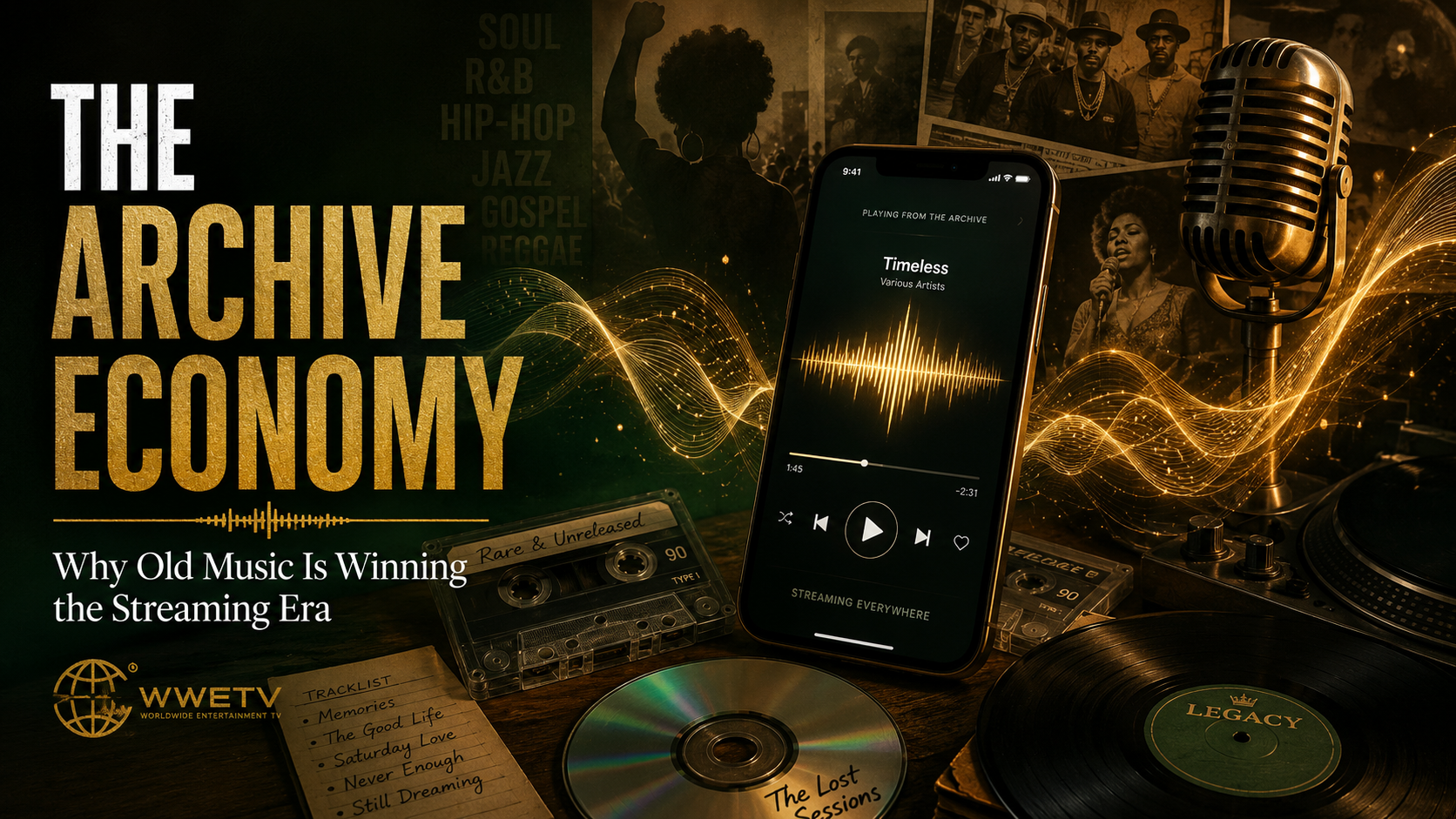
Why Old Music Is Winning Spotify In The Archive Economy
The Archive Economy: Why Old Music Is Winning The Streaming Era
The biggest music trend on Spotify right now may not be a new artist, a new genre, or a new viral dance. It may be the past.
Recent reporting from The Wall Street Journal points to a major nostalgia wave on Spotify, with older songs gaining serious ground on the platform’s global charts. According to the report, one in three Spotify streams now goes to music that is more than a decade old, with Michael Jackson’s “Billie Jean,” Fleetwood Mac’s “Dreams,” and other older records finding new life with younger listeners.
For WorldWide Entertainment TV, this is bigger than streaming data. This is the archive economy.
Old Music Is Not Just Surviving — It Is Competing
Streaming was once sold as the future of music discovery. But the numbers now show that the future keeps reaching backward.
Luminate’s 2025 year-end report showed that global music streams hit a record 5.1 trillion in 2025, up 9.6% from the previous year. In the United States, on-demand audio streams reached 1.4 trillion. But the most important detail is what listeners are choosing: less than half of U.S. on-demand audio streams came from tracks released in the last five years.
That means older music is not just background noise. It is taking up real space in the streaming marketplace.
This helps explain why Michael Jackson’s catalog is moving like a current act in 2026. His song “Chicago,” originally released on the posthumous Xscape album in 2014, debuted at No. 30 on the Billboard Hot 100, making Jackson the first artist to chart new Hot 100 hits across six different decades. The song’s return was driven by streaming growth, TikTok discovery, and renewed attention around the Michael biopic.
The Michael Jackson Example
Michael Jackson is the clearest proof that catalog music has entered a new era.
A song does not have to be new to feel new to the algorithm. It only needs a new audience, a new emotional context, or a new cultural trigger.
That is why a record like “Chicago” can return years after release. It is not only nostalgia for older fans. For younger listeners, it can be a first discovery. For TikTok users, it can be a sound. For longtime fans, it can be a reminder. For the industry, it becomes a data point.
This is where the archive becomes active.
Michael Jackson’s catalog is no longer only a museum piece. It is part of the current streaming economy, the biopic economy, the social media economy, and the Black Music Month conversation all at once.
The Archive Economy Explained
The archive economy is what happens when older cultural material becomes newly valuable because of modern platforms.
It includes:
- Catalog music returning through TikTok and Spotify playlists.
- Old interviews becoming new evidence in today’s debates.
- Classic performances being rediscovered by younger viewers.
- Biopics and documentaries sending audiences back to original records.
- Fans using old footage to challenge or defend legacy narratives.
- Independent media platforms preserving moments before they disappear.
Music Business Worldwide, citing Luminate data, reported that streaming platforms now host roughly a quarter of a billion tracks. But attention is extremely concentrated: 88% of tracks received 1,000 or fewer plays in 2025, while about 0.2% of available tracks accounted for nearly half of global audio streaming consumption.
That makes trusted cultural memory more important, not less.
When there is too much content, audiences need context. They need someone to explain why a song, performance, interview, or artist still matters.
That is where archive-driven media wins.
Why This Matters For Black Music Month
Black Music Month is not only about celebrating the past. It is about understanding how the past keeps powering the present.
Michael Jackson returning to the charts, BET reshaping its future, DMX receiving civic recognition in Yonkers, and older R&B, soul, hip-hop, reggae, and funk records resurfacing online all point to the same truth: Black music history is still commercially and culturally alive.
The industry may call it catalog. Fans may call it nostalgia. But culturally, it is memory.
That memory shaped television through BET, Soul Train, Rap City, 106 & Park, MTV, MuchMusic, and local access platforms. It shaped cities through New York hip-hop, Toronto’s Little Jamaica, Atlanta’s music infrastructure, Yonkers and Ruff Ryders history, and Caribbean influence across North America.
When those stories resurface, they are not random throwbacks. They are receipts.
WWETV Takeaway
The streaming era did not make archives irrelevant. It made them more valuable.
A rare interview, an old performance, a forgotten quote, or a city-specific cultural moment can become newly important when the algorithm pushes a song back into public conversation. That is why WorldWide Entertainment TV’s archive mission matters.
WWETV has already seen this through Michael Jackson-related Toronto archive clips, LL Cool J speaking on MJ, Beyoncé and Usher explaining Michael’s blueprint, DMX/Yonkers legacy coverage, Rob Base tributes, and Black entertainment history content that connects yesterday’s footage to today’s debate.
The archive is no longer just where culture is stored.
It is where the next wave of discovery begins.
Share this content:










Post Comment